
Product Description
Aokman Drive High torque K series helical bevel gear motor reducer gearbox
Product Description
Description: K Series Helical Bevel Gearbox
Overview
(1) Input mode: coupled motor, belted motor, input shaft or connection flange.
(2) Right angle output.
(3) Compact structure.
(4) Rigid tooth face.
(5) Carrying greater torque, high loading capacity.
(6) High precision gear, ensuring the unit to operate stably, smooth transmission.
(7) Low noise, long lifespan.
(8) Large overlap coefficient, abrasion resistant.
Detailed Photos
K series gear units are available in the following designs:
KAZ..Y..Short-flange-mounted helical-bevel gear units with hollow shaft
K…Y…Foot-mounted helical-bevel gear units with CHINAMFG shaft
KAT…Y…Torque-arm-mounted helical-bevel gear units with hollow shaft
KAB…Y…Foot-mounted helical-bevel gear units with hollow shaft
K(KF,KA,KAF,KAB,KAZ)S…Shaft input helical-bevel gear units
KA…Y…Helical-bevel gear units with hollow shaft
KA(K, KF ,KAF, KAB ,KAZ)R..Y..Combinatorial helical-bevel gear units
KF…Y…Flange-mounted helical-bevel gear units with CHINAMFG shaft
KA(K, KF ,KAF ,KAZ)S…R…Shaft input combinatorial helical-bevel gear units
KAF…Y…Flange-mounted helical-bevel gear units with hollow shaft
KA(K, KF ,KAF, KAB ,KAZ)…Y…When equipping the user’s motor or the special 1 ,the flange is required to be connected
The weights are mean values, only for reference.
Maximum torque means the biggest 1 of the maximum torque related to the different ratio for the specified size.
Rated Power:0.18KW~200KW
Rated Torque:Up to 50000N.m
Gear Arrangement:Bevel Helical Hardened Gearbox
Input Speed:50HZ or 60HZ of 4Pole,6Pole and 8pole motor
Ratio:5.36~192.18
Product Parameters
Structure:
| K(-) |
K(A) | K(F) | Input power range | Output speed | Output torque |
| Foot-mounted | Hollow shaft output |
Flange-mounted | 0.18-200kw | 0.1-270r/min | Up to 50000Nm |
Input power rating and maximum torque:
| Size |
38 | 48 | 58 | 68 | 78 | 88 | 98 | 108 | 128 | 158 | 168 | 188 |
| Structure |
K KA KF KAF KAZ KAT KAB | |||||||||||
| Input power rating(kw) |
0.18~ 3.0 |
0.18~ 3.0 |
0.18~ 5.5 |
0.18~ 5.5 |
0.37~ 11 |
0.75~ 22 |
1.3~ 30 |
3~ 45 |
7.5~ 90 |
11~ 160 |
11~ 200 |
18.5~ 200 |
| Oran | 5.36~ 106.38 |
5.81~ 131.87 |
6.57~ 145.15 |
7.14~ 44.79 |
7.22~ 192.18 |
7.19~ 197.27 |
8.95~ 175.47 |
8.74~ 141.93 |
8.68~ 146.07 |
12.66~ 150.03 |
17.35~1 64.44 |
17.97~ 178.37 |
| Maximum Torque(N.m) |
200 | 400 | 600 | 820 | 1550 | 2770 | 4300 | 8000 | 13000 | 18000 | 32000 | 50000 |
Gear unit weight:
| Size |
38 | 48 | 58 | 68 | 78 | 88 | 98 | 108 | 128 | 158 | 168 | 188 |
| Weight |
11 | 20 | 27 | 33 | 57 | 85 | 130 | 250 | 380 | 610 | 1015 | 1700 |
Packaging & Shipping
Company Profile
After Sales Service
| Pre-sale services | 1. Select equipment model. |
| 2.Design and manufacture products according to clients’ special requirement. | |
| 3.Train technical personal for clients | |
| Services during selling | 1.Pre-check and accept products ahead of delivery. |
| 2. Help clients to draft solving plans. | |
| After-sale services | 1.Assist clients to prepare for the first construction scheme. |
| 2. Train the first-line operators. | |
| 3.Take initiative to eliminate the trouble rapidly. | |
| 4. Provide technical exchanging. |
FAQ
1. How to choose a gearbox which meets our requirement?
You can refer to our catalogue to choose the gearbox or we can help to choose when you provide
the technical information of required output torque, output speed and motor parameter etc.
2. What information shall we give before placing a purchase order?
a) Type of the gearbox, ratio, input and output type, input flange, mounting position, and motor information etc.
b) Housing color.
c) Purchase quantity.
d) Other special requirements.
3. What industries are your gearboxes being used?
Our gearboxes are widely used in the areas of textile, food processing, beverage, chemical industry,
escalator,automatic storage equipment, metallurgy, environmental protection, logistics and etc.
4.Do you offer any visiting?
Yes! We sincerely invite you to visit us! We can pick you from airport, railway station and so on. Also, we can arrange housing for you. Please let us know in advanced.
5.Is your quality good?
Quality never tell lies, we’re theprofessional manufacturer and exporter of gear reducer and motor in Asia, who has been given license since 1982. Also, we had achieved ISO9001 and CE Certificate among all manufacturers.
Contact:
If you are interested in our product, welcome you contact me.
Our team will support any need you might have. /* October 22, 2571 15:47:17 */(()=>{function d(e,r){var a,o={};try{e&&e.split(“,”).forEach(function(e,t){e&&(a=e.match(/(.*?):(.*)$/))&&1
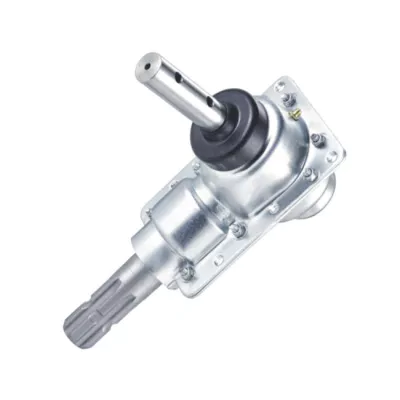
Advantages of Bevel Gearboxes in Specific Scenarios
Bevel gearboxes offer distinct advantages in certain scenarios, making them preferred over other gearbox types:
- Angular Transmission: When rotational motion needs to be transmitted between intersecting shafts at different angles, bevel gearboxes excel due to their ability to change direction.
- Compact Spaces: Bevel gearboxes are well-suited for applications with limited space, as they can fit into tight configurations without sacrificing performance.
- High Torque at 90 Degrees: In situations requiring high torque transmission at a 90-degree angle, bevel gearboxes are more efficient than other types.
- Steering Mechanisms: Bevel gearboxes are commonly used in steering systems of vehicles and machinery, providing smooth and accurate directional control.
- Complex Motion Requirements: When machinery or equipment requires intricate motion patterns involving changes in direction and speed, bevel gearboxes offer the necessary versatility.
- Heavy-Duty Applications: Bevel gearboxes excel in heavy-duty environments where robustness, torque transmission, and durability are crucial.
The specific design and capabilities of bevel gearboxes make them a preferred choice in these scenarios, contributing to optimal performance and efficiency in various industrial applications.
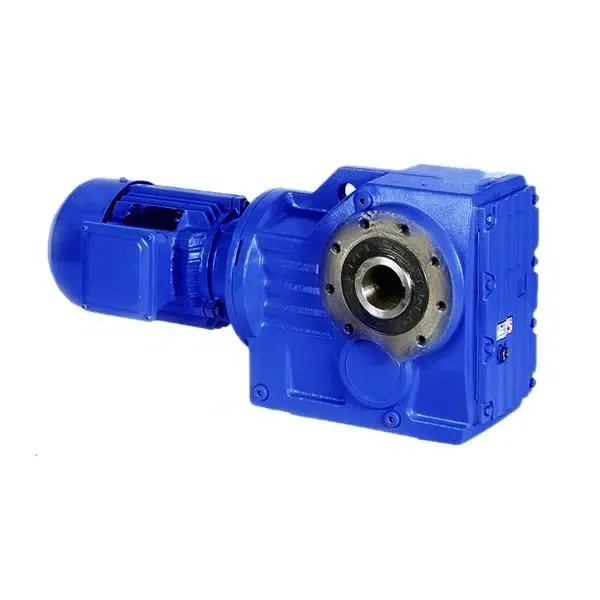
Challenges of Using Bevel Gearboxes
While bevel gearboxes offer various benefits, there are certain challenges that can arise when using them:
- Lubrication: Proper lubrication is essential to reduce friction, wear, and heat generation in bevel gearboxes. However, ensuring effective lubrication in the meshing bevel gears can be challenging due to their complex geometry and the potential for oil pooling or inadequate coverage.
- Noise and Vibration: Bevel gearboxes can produce noise and vibration during operation, especially at higher speeds. The interaction of the gear teeth can lead to noise generation, which may require additional measures such as sound insulation or vibration dampening to mitigate.
- Alignment: Precise alignment of the bevel gears is crucial to ensure smooth and efficient power transmission. Misalignment can lead to increased wear, reduced efficiency, and even gear tooth failure. Achieving proper alignment can be more complex in bevel gearboxes compared to other gearbox types.
- Maintenance: Bevel gearboxes may require more frequent maintenance compared to other gear systems. Regular inspections, lubrication checks, and gear tooth profile monitoring are necessary to detect and address any issues before they escalate.
- Space Constraints: The design of bevel gearboxes can be bulky, especially when used in applications that require a high gear ratio. This can pose challenges in situations where space is limited.
- Heat Dissipation: High-speed or heavy-duty applications can generate significant heat in bevel gearboxes. Adequate heat dissipation mechanisms, such as cooling fins or lubrication cooling, may be required to prevent overheating and premature failure.
Engineers and manufacturers need to carefully address these challenges to ensure the reliable and effective use of bevel gearboxes in various applications.
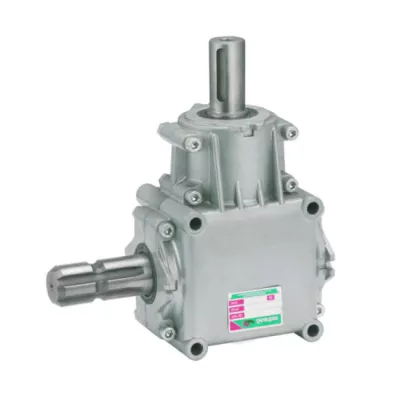
Types of Bevel Gearboxes and Their Classification
Bevel gearboxes come in various types, each designed for specific applications and requirements. They are classified based on factors such as gear arrangement, shaft orientation, and usage. Some common types of bevel gearboxes include:
- Straight Bevel Gearboxes: These gearboxes use straight bevel gears and are suitable for transmitting motion between intersecting shafts at a 90-degree angle.
- Spiral Bevel Gearboxes: These gearboxes use spiral bevel gears and are employed when the intersecting shafts are at angles other than 90 degrees. They offer smoother operation and higher load capacity.
- Skew Bevel Gearboxes: In skew bevel gearboxes, the axes of the input and output shafts are not parallel or intersecting. These gearboxes are used in applications where non-parallel and non-intersecting shafts need to be connected.
- Angular Bevel Gearboxes: Angular bevel gearboxes are designed to connect shafts at a specific angle, often used in applications where the required shaft angle is different from standard bevel gear configurations.
The classification of bevel gearboxes is based on the arrangement and orientation of the gear teeth and shafts. Manufacturers offer a variety of designs to accommodate different industrial needs and ensure efficient motion transmission at various angles.


editor by lmc 2024-11-28