
A spiral konik dişli kutusu changes the direction of rotational power by 90 degrees — a function that appears mechanically straightforward but involves tooth geometry, contact mechanics, and bearing load management that took engineers a century of development to optimise. This guide explains exactly how a spiral bevel gearbox works: from the geometry of the gear teeth, through the mechanics of power transfer, to the bearing arrangement that manages the resulting forces — at a level of technical detail that serves engineers who want to understand the physics behind the specification.
1. The Basic Geometry: Why 90 Degrees?
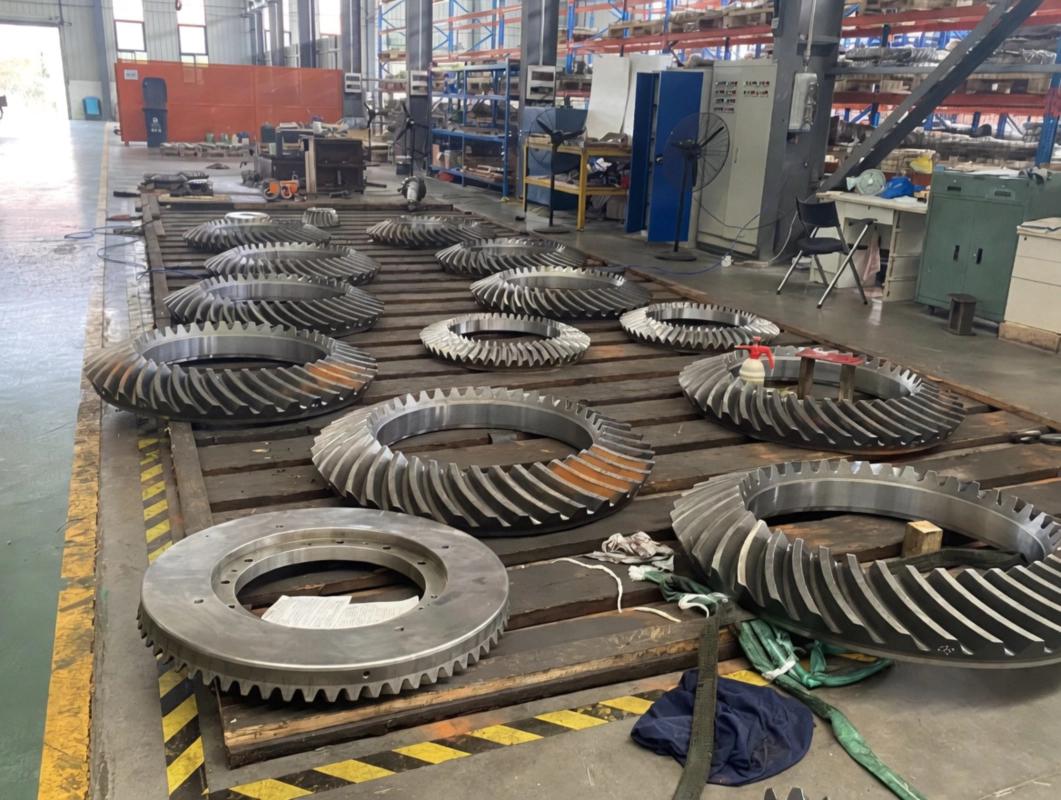
A bevel gear is defined by its conical pitch surface. Imagine two cones with their apices touching at the centre of the gear assembly — the angle between the two cone axes is the shaft angle. For a standard right-angle spiral bevel gearbox, this shaft angle is exactly 90 degrees. The pitch cones of the two gears roll against each other at the apex point — this rolling contact is the fundamental kinematic basis for bevel gear power transmission.
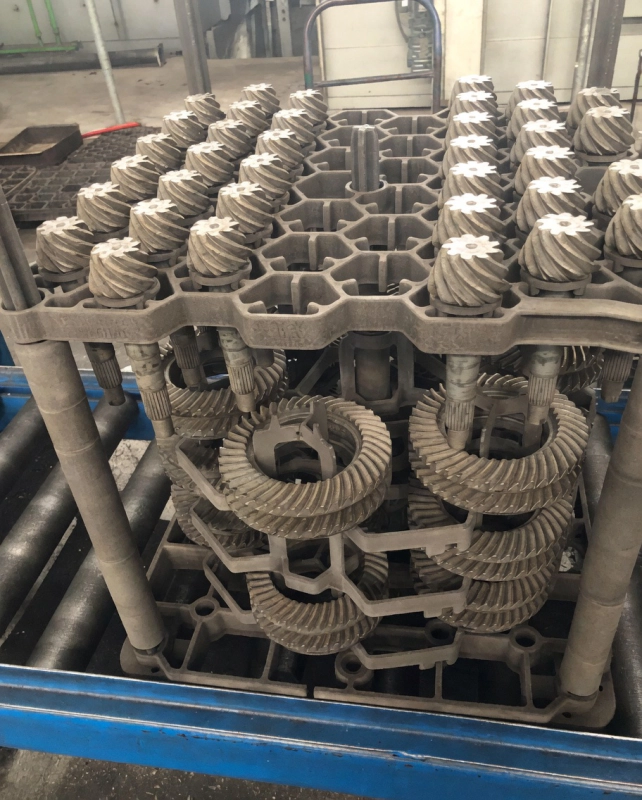
The teeth are cut on the conical surfaces of the gears. In a spiral bevel gear, these teeth follow a spiral curve on the pitch cone surface — curving from the toe (small end) to the heel (large end) of the tooth at a mean spiral angle typically between 30 and 35 degrees. This curvature is what makes the spiral bevel gear fundamentally different from a straight bevel gear, and it is the source of every performance advantage the design holds.
2. How the Spiral Tooth Engages: Progressive Contact
When a straight bevel gear tooth enters the mesh, contact occurs instantaneously across the full face width of the tooth — from toe to heel simultaneously. This sudden full-face contact creates an impact at every tooth entry, generating the characteristic noise and vibration of straight bevel gear drives.
A spiral bevel gear tooth enters the mesh progressively. Because the tooth curves at a spiral angle across the face width, contact begins at the toe and sweeps across the tooth face toward the heel as the gear rotates. By the time contact reaches the heel, the next tooth’s toe has already begun to engage — creating a continuous, overlapping contact zone rather than discrete full-face contacts.
This progressive engagement produces the two defining performance advantages of spiral bevel gears:
- Higher contact ratio (1.5–2.5 vs 1.2–1.5 for straight bevel) — more teeth share the load simultaneously, reducing peak tooth stress and enabling higher load capacity from a physically smaller gear set
- Noise reduction of 40–60% — the gradual force build-up and release eliminates the impact event at tooth entry, reducing gear noise and the vibration transmitted to the housing and machine frame
3. Power Flow: Input to Output
Power flows through a spiral bevel gearbox in a defined sequence:
| Stage | Component | What Happens |
|---|---|---|
| 1 | Input shaft (pinion shaft) | Receives motor torque; rotates at motor speed; drives the bevel pinion |
| 2 | Spiral bevel pinion | Smaller gear on input shaft; helical spiral teeth transfer torque to crown gear through rolling contact |
| 3 | Spiral bevel crown gear | Larger gear on output shaft (perpendicular to pinion shaft); tooth count ratio determines speed change; rotates at output speed |
| 4 | Output shaft (crown gear shaft) | Delivers torque to driven equipment at 90 degrees to input; torque = input torque x ratio x efficiency |
| 5 | Housing and bearings | React the gear mesh separation force; maintain precise shaft alignment; carry combined radial and axial loads to the machine structure |
4. The Forces Generated: Why Thrust Bearings Are Required
The spiral tooth geometry generates three force components at the gear mesh contact:
The useful force that transmits torque. Acts tangentially to the pitch cone surface. This is the force that does the work — all other force components are reactions to this.
Acts radially outward from the gear axis. Tends to push the two gears apart along their pitch cone surfaces. Reacted by the radial load capacity of the bearings.
Acts along the shaft axis. Generated by the spiral tooth helix angle. The magnitude depends on the spiral angle (typically 30–35 degrees) and the tangential force. This is why spiral bevel gearboxes require thrust-capable bearings — typically tapered roller bearings.
The direction of the axial thrust force depends on the hand (left or right) of the spiral and the direction of rotation. Ever Power specifies the gear hand for each unit based on the stated input rotation direction — this determines which bearing in the set must carry the sustained axial load and how the bearing pre-load is set.
5. Bearing Arrangement: Carrying Combined Loads
Both input and output shafts in a spiral bevel gearbox carry combined radial and axial loads. Tapered roller bearings are the standard choice for this load combination — their internal geometry allows them to carry both load types simultaneously in a single compact bearing unit. Ever Power uses matched pairs of tapered roller bearings on both shafts, arranged in either face-to-face or back-to-back configuration depending on the axial load direction and magnitude.
The bearing pairs are pre-loaded during assembly to eliminate internal clearance — reducing the small amount of shaft deflection that occurs under load. Controlled pre-load maintains the precise gear mesh geometry that ISO Grade 5–6 grinding delivers, preventing the tooth contact pattern from shifting under load and generating noise or uneven tooth wear.

6. The Lubrication System: Oil Bath Principles
Ever Power spiral bevel gearboxes use an oil bath lubrication system. Both gear sets are partially submerged in oil — the rotating crown gear carries oil through the gear mesh and onto the pinion by viscous drag. The oil serves three functions simultaneously: it provides hydrodynamic film separation between the meshing gear tooth surfaces (preventing metal-to-metal contact), it lubricates the tapered roller bearings, and it conducts heat from the gear mesh zone to the housing walls, where it dissipates to the surrounding air.
The oil fill level is critical — too low, and the gear mesh receives insufficient oil, leading to accelerated wear. Too high, and the gear set churns excessive oil, generating heat and increasing power losses. Ever Power specifies the correct fill level for each mounting orientation and marks the fill level on the housing. The fill level changes with orientation — always verify when a gearbox is installed in a non-standard position.
7. Manufacturing: How Grade 5–6 Precision Is Achieved
The performance of a spiral bevel gearbox depends entirely on manufacturing precision. The tooth profile geometry must match the theoretical design within microns — deviations cause uneven load distribution, increased noise, and accelerated wear. Ever Power achieves ISO Grade 5–6 precision through the following manufacturing sequence:
| Manufacturing Step | Process | Purpose |
|---|---|---|
| 1. Gear blank turning | CNC lathe | Establish pitch cone angle and blank dimensions |
| 2. Tooth cutting | Gleason or Klingelnberg machine | Cut spiral tooth profile to rough form |
| 3. Heat treatment | Carburizing + controlled quenching | Achieve HRC 58–62 surface hardness; retain HRC 33–40 core toughness |
| 4. Precision grinding | CNC gear grinding | Remove heat treatment distortion; achieve ISO Grade 5–6 tooth accuracy |
| 5. CMM inspection | Coordinate measuring machine | Verify tooth profile, pitch, and lead errors against Grade 5–6 tolerance band |
| 6. Pair matching and assembly | Selective assembly | Match pinion and crown gear as a pair; verify contact pattern under light load before final assembly |
Customer Cases
Germany — Technical University Procurement
A mechanical engineering department purchased Ever Power spiral bevel gearboxes for a drive train test rig comparing gear types under controlled conditions. The measured efficiency at rated load was 95.2% — within the specified range. Contact pattern verification confirmed Grade 5 accuracy. “The manufacturing quality matched the specification exactly. Our test data agreed with the datasheet values.” — Laboratory Engineer
Netherlands — Machine Design Consultancy
A design consultancy specified Ever Power compact spiral bevel units for a client’s prototype automation system. “We needed to understand the thrust force direction before we could size the output shaft coupling. Ever Power’s engineering team calculated the axial force for our specified rotation direction and load within 2 hours of our enquiry — without us having to ask for it.” — Design Engineer, Amsterdam
South Korea — Industrial Drive Systems Integrator
Systems integrator used Ever Power spiral bevel gearboxes across twelve conveyor stations in a logistics facility. Understanding the working principle helped the installation team correctly verify alignment and first oil fill before commissioning. Zero bearing failures in 24 months of operation across all twelve stations.
“The installation documentation was thorough. Our technicians knew exactly what to verify before startup.” — Systems Integration Manager, Seoul
FAQ
Ready to specify a spiral bevel gearbox for your application?
Ever Power’s engineering team applies the principles explained in this guide to every gearbox selection — providing matched specifications, CAD drawings, and CE documentation within 48 hours of receiving your application data.