
Opis produktu
Product Description
| Product Name | R series hard tooth flank gear reducer |
| Gear material | 20CrMnTi |
| Color | Customer Request |
| Case Material | HT250 |
| Shaft Material | 20CrMnTi |
| Gear Processing | Grinding finish by HOFLER Grinding Machines |
| Noise Test | Bellow 65dB |
| Brand of bearings | C&U bearing, ZWZ,LYC, HRB,NSK ,etc |
| Brand of oil seal | NAK or other brand |
| Temp. rise (MAX) | 40ºC |
| Temp. rise (Oil)(MAX) | 50ºC |
| Wibracja | ≤20µm |
R series reducer is a kind of gear is used to reduce the motor speed and improve the output torque of the principle of speed reducer. It uses the gear and gear meshing, with advanced design and novel structure of retarding mechanism.
It has beenwidely used in metallurgy, mining, petroleum, chemical industry, ship, light industry, food, textile, printing and dyeing.
Product Feature
Our R series helical gear reducers are based on the building block design, so its convenientfor them to fit all types of motors or to connect with other power input, and its possiblefor different types of machines to combine or connect.
1. Compact construction, saves space for mounting, large load-bearing capacity and long life.
2. High transmission efficiency and low noise. A single machine can reach a transmission efficiency as much as 96%.
3. Precise division of transmission ratio with a wide range. The combination of machines can produce a larger transmission ratio at a low output rotational speed.
4. Installation: Foot-mounted, B5/B14 flange-mounted, input shaft, hollow output shaft, etc.
Input power rating and permissible torque
| Rozmiar | 37 | 57 | 67 | 77 | 87 | 97 | 107 | 127 | 157 | |
| Struktura | RX RXF | |||||||||
| Rated Power(kw) | 0.18-1.1 | 0.18-5.5 | 0.18-7.5 | 1.1-11 | 3-22 | 5.5-30 | 7.4-45 | 7.5-90 | 11-132 | |
| Stosunek | 1.62-4.43 | 1.3-5.5 | 1.4-6.07 | 1.42-8.00 | 1.39-8.65 | 1.42-8.23 | 1.44-6.63 | 1.51-6.2 | 1.57-6.2 | |
| Torque | 20 | 70 | 135 | 215 | 400 | 600 | 830 | 1110 | 1680 | |
| Gear Unit Weight | |||||||||||||
| Gear Unit Type | R17 | R27 | R37 | R47 | R57 | R67 | R77 | R87 | R97 | R107 | R137 | R147 | R167 |
| Weight(kg) |
4 | 5.5 | 8.5 | 10 | 18 | 25 | 36 | 63 | 101 | 153 | 220 | 400 | 700 |
| Gear Unit Type | RX37 | RX57 | RX67 | RX77 | RX87 | RX97 | RX107 | RX127 | RX157 | ||||
| Weight(kg) | 5 | 8 | 14 | 23 | 39 | 70 | 100 | 150 | 250 | ||||
| The weight are mean values, only for reference | |||||||||||||
Gear Unit Version
| Single Stage | Rozmiar | |||||||||||
| 57 | 67 | 77 | 87 | 97 | 107 | |||||||
| RX.. | Montowany na stopach | RX57 | RX67 | RX77 | RX87 | RX97 | RX107 | |||||
| RXF.. | Montaż kołnierzowy | RXF57 | RXF67 | RXF77 | RX87 | RX97 | RX107 | |||||
| Multi-stage | Rozmiar (17/27/37/47/57/67/77/87/97/107/137/147/167) | |||||||||||
| R.. | Montowany na stopach | R17 | R27 | R37 | R47 | R57 | R67 | |||||
| R..F | Foot-mounted and flange-mounted | R17F | R27F | R37F | R47F | R57F | R67F | |||||
| RF.. | B5 flange-mounted | RF17 | RF27 | RF37 | RF47 | RF57 | RF67 | |||||
| Multi-stage | Rozmiar (17/27/37/47/57/67/77/87/97/107/137/147/167) | ||||||
| R.. | R77 | R87 | R97 | R107 | R137 | R147 | R167 |
| R..F | R77F | R87F | R97F | R107F | R137F | R147F | R167F |
| RF.. | RF77 | RF87 | RF97 | RF107 | RF137 | RF147 | RF167 |
Application
Shipping & Tracking
/* January 22, 2571 19:08:37 */!function(){function s(e,r){var a,o={};try{e&&e.split(“,”).forEach(function(e,t){e&&(a=e.match(/(.*?):(.*)$/))&&1
| Application: | Machinery |
|---|---|
| Hardness: | Hardened Tooth Surface |
| Installation: | as Request |
| Layout: | Coaxial |
| Step: | Three-Step |
| Type: | Bevel Gear |
| Samples: |
US$ 1/Piece
1 Piece(Min.Order) | |
|---|
| Customization: |
Available
| Customized Request |
|---|
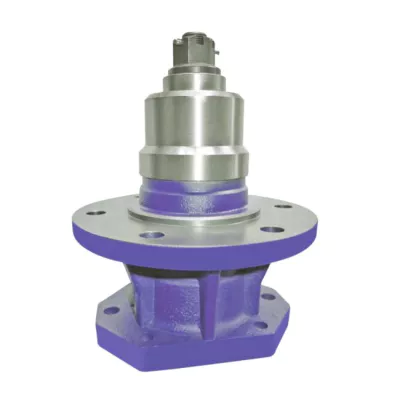
Handling High Torque and Speed Requirements in Bevel Gearboxes
Bevel gearboxes are versatile mechanical components capable of handling a wide range of torque and speed requirements, making them suitable for various industrial applications.
The ability of bevel gearboxes to handle high torque and speed requirements depends on several factors:
- Gear Material: The choice of gear material greatly influences the torque and speed capacity of the bevel gearbox. High-strength materials like alloy steel or hardened steel are often used to withstand higher loads and speeds.
- Design and Tooth Profile: The design of the bevel gears, including the tooth profile and size, plays a significant role in determining their load-bearing capacity and efficiency. Precisely engineered tooth profiles ensure smooth and efficient power transmission.
- Lubrication and Cooling: Proper lubrication and cooling mechanisms are essential to manage heat generated during high-speed and high-torque operations. Adequate lubrication reduces friction and wear, enhancing the gearbox’s overall performance and longevity.
- Bearing Selection: High-quality bearings that can handle both radial and axial loads are critical in supporting the rotational motion and absorbing forces generated by high torque and speed.
- Alignment and Installation: Accurate alignment and installation of the bevel gearbox are vital to prevent misalignment-related issues that can lead to premature failure under high loads.
Bevel gearboxes are commonly used in applications where both high torque and speed are required, such as heavy machinery, vehicles, industrial equipment, and more. Proper engineering, material selection, and maintenance practices contribute to the ability of bevel gearboxes to efficiently handle the demands of various high-performance scenarios.
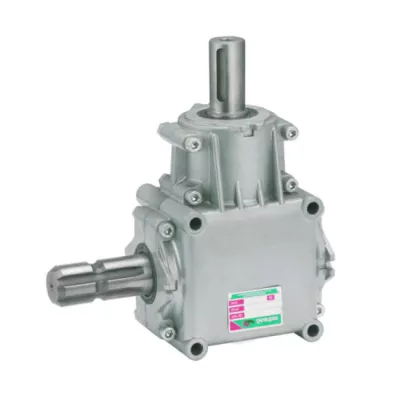
Lubrication Requirements for Maintaining Bevel Gearbox Efficiency
Proper lubrication is crucial for maintaining the efficiency and longevity of bevel gearboxes. Here are the essential lubrication requirements:
- Selection of Lubricant: Choose a high-quality lubricant specifically designed for bevel gear applications. The lubricant should have the appropriate viscosity and additives to withstand the operating conditions and loads.
- Correct Lubricant Quantity: Follow the manufacturer’s recommendations for the correct lubricant quantity. Insufficient lubrication can lead to increased friction and wear, while over-lubrication can cause overheating and inefficient operation.
- Lubrication Intervals: Establish a regular lubrication schedule based on the gearbox’s operating conditions. Factors such as load, speed, temperature, and environment can influence the frequency of lubrication.
- Proper Lubrication Points: Identify all the necessary lubrication points on the bevel gearbox, including bearings, gears, and other moving parts. Ensure that lubricant is applied precisely to these points for optimal coverage.
- Cleanliness: Keep the gearbox and its surrounding area clean to prevent contamination of the lubricant. Dirt, debris, and moisture can compromise the lubrication effectiveness and accelerate wear.
- Temperature Considerations: Choose a lubricant with temperature stability suitable for the operating conditions. Extreme temperatures can affect lubricant viscosity and performance.
- Monitoring: Regularly monitor the condition of the lubricant, including its color, consistency, and contamination level. Perform oil analysis if necessary to assess the lubricant’s health.
- Lubricant Compatibility: Ensure that the chosen lubricant is compatible with the gearbox materials to prevent corrosion or damage.
- Re-lubrication: During routine maintenance, clean and reapply lubricant as needed. Replace the lubricant when it reaches the end of its service life.
Adhering to proper lubrication requirements enhances the efficiency, performance, and reliability of bevel gearboxes, reducing friction, wear, and the risk of premature failure.
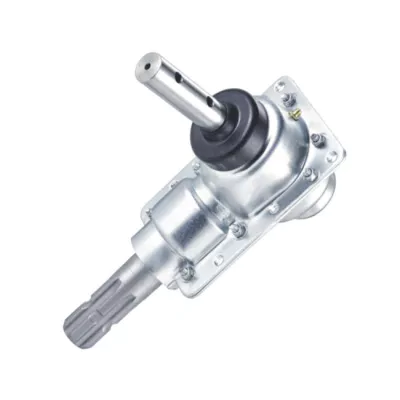
Direction of Rotational Motion Change by Bevel Gears in a Bevel Gearbox
Bevel gears in a bevel gearbox are specifically designed to change the direction of rotational motion between intersecting shafts. They achieve this by utilizing the unique geometry of their tooth profiles, which allows them to transmit motion smoothly and efficiently even when the shafts are positioned at an angle other than 90 degrees.
When two bevel gears mesh together, their teeth engage and transfer rotational force from one gear to the other. Depending on the gear arrangement, the direction of rotation can be changed from input to output or vice versa. For example, in a straight bevel gear arrangement, the gears are set at a 90-degree angle, and the input and output shafts are perpendicular to each other. As the input gear rotates, it transfers its motion to the output gear, resulting in a change in the direction of rotation between the two shafts.
In more complex configurations, such as spiral bevel gears, the teeth are designed in a spiral pattern, which allows for smoother engagement and better load distribution. This makes them suitable for applications where higher torque and efficiency are required, and the shafts are positioned at angles other than 90 degrees.
In summary, bevel gears in a bevel gearbox are essential components that enable the transmission of rotational motion and power between intersecting shafts while changing the direction of rotation as needed for various mechanical systems and industrial applications.


editor by CX 2024-04-09