
Opis produktu
> Product Introduction
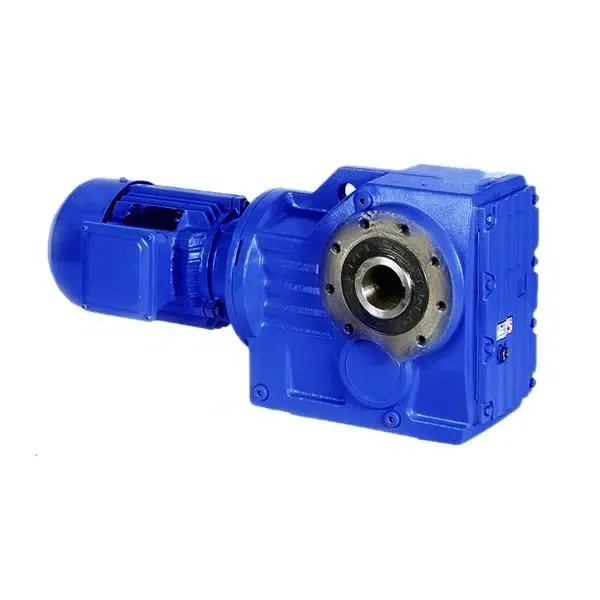
90 Degree Bevel Helical Transmission Gearbox
K helical speed gearbox motor is designed based on modularization, which bring many difference kinds of combinations, mounting types, and structure designs. The detail classification of ratio can meet various of working condition. High Transmission efficiency, low energy consumption, superior performance. The hard tooth surface gear use the high quality alloy steel, the process of carburizing and quenching, grinding ,which give it following characters: Stable transmission, low noise and temperature, high loading, long working life.
> gearbox Motor Materials
| housing material: | HT2OO high-strength cast iron or HT250 High strength cast iron |
| Gear material: | 20CrMnTi |
| Housing hardness | HBS90-240 |
| Surface hardness of gear | HRC58°-62° |
| Gear core hardness | HRC33°-40° |
| Input/Output shaft material | 40Cr |
| Input/Output shaft hardness | HBS241°-286° |
| Shaft at oil seal position hardness | HRC48 ° -55 ° |
| Machining precision of gears material | Accurate grinding 6-5 grade |
| Efficiency | up to 98% |
| Noise(Max) | 60-68dB |
| Temp.rise: | 40°C |
| Wibracja | ≤20um |
| Motor | IP54, F class ,B5 FLANGE |
| color : | blue (if you need big quantity ,we can done as your wanted color ) |
>GEARBOX CATALOGUE :
> Producing Process
> WORKSHOP EQUIPMENT:
CERTIFICATION :
> PACKAGE :
for 1 container, directly loading ,for less, all goods with pallet,
Często zadawane pytania
1, Q:what’s your MOQ for ac gearbox motor ?
A: 1pc is ok for each type electric gear box motor
2, Q: What about your warranty for your induction speed reducer motor ?
A: 1 year ,but except man-made destroyed
3, Q: which payment way you can accept ?
A: TT, western union .
4, Q: how about your payment way ?
A: 100%payment in advanced less $5000 ,30% payment in advanced payment , 70% payment before sending over $5000.
5, Q: how about your packing of speed reduction motor ?
A: plywood case ,if size is small ,we will pack with pallet for less 1 container
6, Q: What information should be given, if I buy electric helical geared motor from you ?
A: rated power, ratio or output speed,type ,voltage , mounting way , quantity , if more is better.
| Application: | Motor, Machinery, Agricultural Machinery |
|---|---|
| Layout: | Bevel |
| Hardness: | Hardened Tooth Surface |
| Installation: | Horizontal Type |
| Step: | Double-Step |
| Type: | Bevel |
| Customization: |
Available
| Customized Request |
|---|
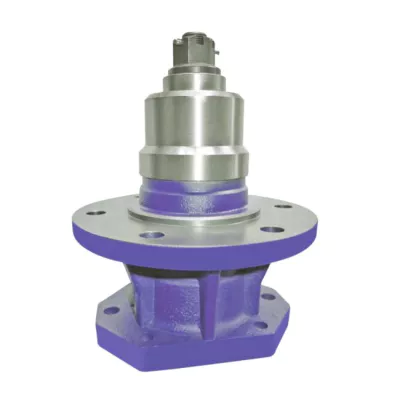
Handling High Torque and Speed Requirements in Bevel Gearboxes
Bevel gearboxes are versatile mechanical components capable of handling a wide range of torque and speed requirements, making them suitable for various industrial applications.
The ability of bevel gearboxes to handle high torque and speed requirements depends on several factors:
- Gear Material: The choice of gear material greatly influences the torque and speed capacity of the bevel gearbox. High-strength materials like alloy steel or hardened steel are often used to withstand higher loads and speeds.
- Design and Tooth Profile: The design of the bevel gears, including the tooth profile and size, plays a significant role in determining their load-bearing capacity and efficiency. Precisely engineered tooth profiles ensure smooth and efficient power transmission.
- Lubrication and Cooling: Proper lubrication and cooling mechanisms are essential to manage heat generated during high-speed and high-torque operations. Adequate lubrication reduces friction and wear, enhancing the gearbox’s overall performance and longevity.
- Bearing Selection: High-quality bearings that can handle both radial and axial loads are critical in supporting the rotational motion and absorbing forces generated by high torque and speed.
- Alignment and Installation: Accurate alignment and installation of the bevel gearbox are vital to prevent misalignment-related issues that can lead to premature failure under high loads.
Bevel gearboxes are commonly used in applications where both high torque and speed are required, such as heavy machinery, vehicles, industrial equipment, and more. Proper engineering, material selection, and maintenance practices contribute to the ability of bevel gearboxes to efficiently handle the demands of various high-performance scenarios.
Challenges of Using Bevel Gearboxes
While bevel gearboxes offer various benefits, there are certain challenges that can arise when using them:
- Lubrication: Proper lubrication is essential to reduce friction, wear, and heat generation in bevel gearboxes. However, ensuring effective lubrication in the meshing bevel gears can be challenging due to their complex geometry and the potential for oil pooling or inadequate coverage.
- Noise and Vibration: Bevel gearboxes can produce noise and vibration during operation, especially at higher speeds. The interaction of the gear teeth can lead to noise generation, which may require additional measures such as sound insulation or vibration dampening to mitigate.
- Alignment: Precise alignment of the bevel gears is crucial to ensure smooth and efficient power transmission. Misalignment can lead to increased wear, reduced efficiency, and even gear tooth failure. Achieving proper alignment can be more complex in bevel gearboxes compared to other gearbox types.
- Maintenance: Bevel gearboxes may require more frequent maintenance compared to other gear systems. Regular inspections, lubrication checks, and gear tooth profile monitoring are necessary to detect and address any issues before they escalate.
- Ograniczenia przestrzenne: The design of bevel gearboxes can be bulky, especially when used in applications that require a high gear ratio. This can pose challenges in situations where space is limited.
- Heat Dissipation: High-speed or heavy-duty applications can generate significant heat in bevel gearboxes. Adequate heat dissipation mechanisms, such as cooling fins or lubrication cooling, may be required to prevent overheating and premature failure.
Engineers and manufacturers need to carefully address these challenges to ensure the reliable and effective use of bevel gearboxes in various applications.
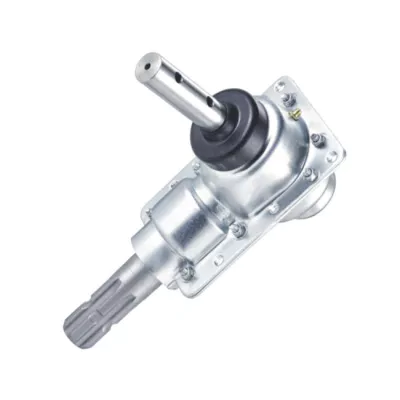
Direction of Rotational Motion Change by Bevel Gears in a Bevel Gearbox
Bevel gears in a bevel gearbox are specifically designed to change the direction of rotational motion between intersecting shafts. They achieve this by utilizing the unique geometry of their tooth profiles, which allows them to transmit motion smoothly and efficiently even when the shafts are positioned at an angle other than 90 degrees.
When two bevel gears mesh together, their teeth engage and transfer rotational force from one gear to the other. Depending on the gear arrangement, the direction of rotation can be changed from input to output or vice versa. For example, in a straight bevel gear arrangement, the gears are set at a 90-degree angle, and the input and output shafts are perpendicular to each other. As the input gear rotates, it transfers its motion to the output gear, resulting in a change in the direction of rotation between the two shafts.
In more complex configurations, such as spiral bevel gears, the teeth are designed in a spiral pattern, which allows for smoother engagement and better load distribution. This makes them suitable for applications where higher torque and efficiency are required, and the shafts are positioned at angles other than 90 degrees.
In summary, bevel gears in a bevel gearbox are essential components that enable the transmission of rotational motion and power between intersecting shafts while changing the direction of rotation as needed for various mechanical systems and industrial applications.


editor by CX 2023-10-26