
Description du produit
Helical Gear Motor (K Type)
|
Input Configurations |
Direct motor coupled |
|
with IEC B5/B14 motor flange |
|
|
with IEC B5/B14 motor mounted |
|
|
with CHINAMFG input shaft |
|
|
Output Configurations |
CHINAMFG output shaft |
|
CHINAMFG output shaft with flange |
|
|
Hollow output shaft |
|
|
Hollow output shaft with flange |
|
|
Variants of the Helical Bevel Gear Unit Series K / KF / KA / KAF |
Foot- or flange-mounted |
|
B5 or B14 flange-mounted |
|
|
CHINAMFG shaft or hollow shaft |
|
|
Hollow shaft with keyed connection, shrink disk, splined hollow shaft, or Torque Arm |
Main Feature
With their high efficiency in both directions of rotation and at any input speed, these right-angle gear units are very energy-efficient. Their high-endurance gearing is wear-free and lasts a gear unit’s lifetime.
Spécification
|
Modèle |
Shaft Dia. mm |
Horizontal Center Height mm |
External Flange Dia. mm |
Pouvoir |
Rapport (i) |
Nominal Torque (Nm) |
|
|
CHINAMFG Shaft |
Hollow Shaft |
||||||
|
K/KF/KA/KAF37 |
ф25 |
ф30 |
100 |
160 |
0.12-2.2 |
8-102 |
180 |
|
K/KF/KA/KAF47 |
ф30 |
ф35 |
112 |
200 |
0.18-4 |
8-126 |
380 |
|
K/KF/KA/KAF57 |
ф35 |
ф40 |
132 |
250 |
0.25-5.5 |
8-143 |
580 |
|
K/KF/KA/KAF67 |
ф40 |
ф40 |
140 |
250 |
0.37-7.5 |
8-143 |
680 |
|
K/KF/KA/KAF77 |
ф50 |
ф50 |
180 |
300 |
0.75-11 |
8-175 |
1300 |
|
K/KF/KA/KAF87 |
ф60 |
ф60 |
212 |
350 |
1.5-18.5 |
8-197 |
2500 |
|
K/KF/KA/KAF97 |
ф70 |
ф70 |
265 |
450 |
2.2-30 |
8-197 |
3900 |
|
K/KF/KA/KAF107 |
ф90 |
ф90 |
315 |
450 |
4-45 |
8-197 |
6800 |
|
K/KF/KA/KAF127 |
ф110 |
ф100 |
375 |
550 |
7.5-90 |
8-197 |
11200 |
|
K/KF/KA/KAF157 |
ф120 |
ф120 |
450 |
660 |
11-110 |
8-198 |
11700 |
|
K/KF/KA/KAF167 |
ф160 |
ф135 |
500 |
– |
15-160 |
8-186 |
32000 |
|
K/KF/KA/KAF187 |
ф190 |
ф155 |
600 |
– |
18.5-200 |
8-186 |
50000 |
Ratio:35.62
Input Configuration: CHINAMFG Input Shaft
Output Configuration: Hollow Shaft with Double Output Flange
Profil de l'entreprise
Packing
Scenarioes
FAQ
Q1: I want to buy your products, how can I pay?
A: You can pay via T/T(30%+70%), L/C ,D/P etc.
Q2: How can you guarantee the quality?
A: One year’s warranty against B/L date. If you meet with quality problem, please send us pictures or video to check, we promise to send spare parts or new products to replace. Our guarantee not include inappropriate operation or wrong specification selection.
Q3: How we select models and specifications?
A: You can email us the series code (for example: RC series helical gearbox) as well as requirement details, such as motor power,output speed or ratio, service factor or your application…as much data as possible. If you can supply some pictures or drawings,it is nice.
Q4: If we don’t find what we want on your website, what should we do?
A: We offer 3 options:
1, You can email us the pictures, drawings or descriptions details. We will try to design your products on the basis of our
standard models.
2, Our R&D department is professional for OEM/ODM products by drawing/samples, you can send us samples, we do customized design for your bulk purchasing.
3, We can develop new products if they have good market. We have already developed many items for special using successful, such as special gearbox for agitator, cement conveyor, shoes machines and so on.
Q5: Can we buy 1 pc of each item for quality testing?
A: Yes, we are glad to accept trial order for quality testing.
Q6: How about your product delivery time?
A: Normally for 20’container, it takes 25-30 workdays for RV series worm gearbox, 35-40 workdays for helical gearmotors.
/* March 10, 2571 17:59:20 */!function(){function s(e,r){var a,o={};try{e&&e.split(“,”).forEach(function(e,t){e&&(a=e.match(/(.*?):(.*)$/))&&1
| Application: | Machinery, Agricultural Machinery |
|---|---|
| Dureté: | Surface dentaire durcie |
| Gear Shape: | Bevel Gear |
| Étape: | Three-Step |
| Type: | Gear Reducer |
| Ratio: | 35.62 |
| Exemples : |
US$ 660/Piece
1 pièce (commande minimale) | |
|---|
| Personnalisation : |
Disponible
| Demande personnalisée |
|---|
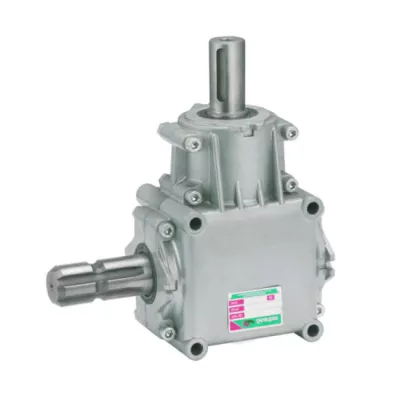
Performance of Bevel Gearboxes in Heavy-Duty Applications like Construction Equipment
Bevel gearboxes are well-suited for heavy-duty applications such as construction equipment due to their robust design and reliable performance:
- Durability: Bevel gearboxes are designed to withstand high loads, shocks, and impacts commonly encountered in construction environments.
- Torque Transmission: Construction equipment requires high torque to move heavy loads, and bevel gearboxes efficiently transmit torque between intersecting shafts.
- Directional Changes: Bevel gearboxes enable smooth and precise changes in rotational direction, crucial for controlling construction machinery.
- Power Distribution: These gearboxes ensure efficient power distribution to various components of construction equipment, enhancing overall functionality.
- Steering Mechanisms: Many construction vehicles rely on bevel gearboxes for their steering systems, allowing operators to navigate equipment with ease.
- Reliability: In demanding construction conditions, bevel gearboxes offer reliable and consistent performance, minimizing downtime and maintenance needs.
The ability of bevel gearboxes to handle heavy loads, transmit torque, and facilitate directional changes makes them indispensable components in construction equipment, contributing to the efficiency and effectiveness of various construction operations.
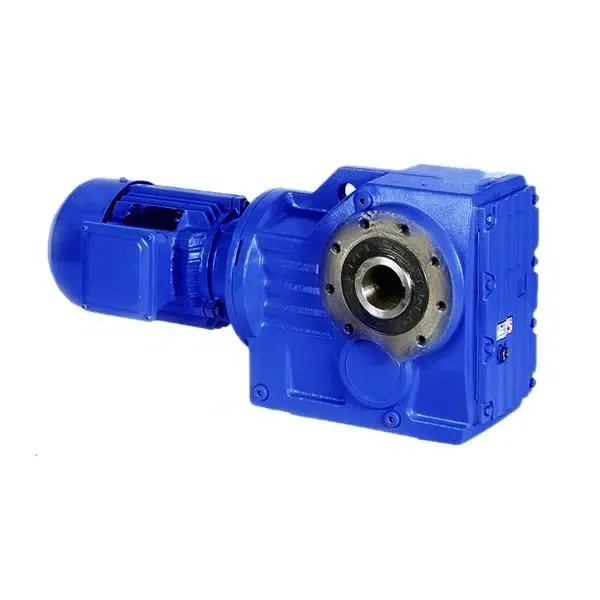
Challenges of Using Bevel Gearboxes
While bevel gearboxes offer various benefits, there are certain challenges that can arise when using them:
- Lubrification: Proper lubrication is essential to reduce friction, wear, and heat generation in bevel gearboxes. However, ensuring effective lubrication in the meshing bevel gears can be challenging due to their complex geometry and the potential for oil pooling or inadequate coverage.
- Noise and Vibration: Bevel gearboxes can produce noise and vibration during operation, especially at higher speeds. The interaction of the gear teeth can lead to noise generation, which may require additional measures such as sound insulation or vibration dampening to mitigate.
- Alignment: Precise alignment of the bevel gears is crucial to ensure smooth and efficient power transmission. Misalignment can lead to increased wear, reduced efficiency, and even gear tooth failure. Achieving proper alignment can be more complex in bevel gearboxes compared to other gearbox types.
- Maintenance: Bevel gearboxes may require more frequent maintenance compared to other gear systems. Regular inspections, lubrication checks, and gear tooth profile monitoring are necessary to detect and address any issues before they escalate.
- Contraintes d'espace : The design of bevel gearboxes can be bulky, especially when used in applications that require a high gear ratio. This can pose challenges in situations where space is limited.
- Heat Dissipation: High-speed or heavy-duty applications can generate significant heat in bevel gearboxes. Adequate heat dissipation mechanisms, such as cooling fins or lubrication cooling, may be required to prevent overheating and premature failure.
Engineers and manufacturers need to carefully address these challenges to ensure the reliable and effective use of bevel gearboxes in various applications.
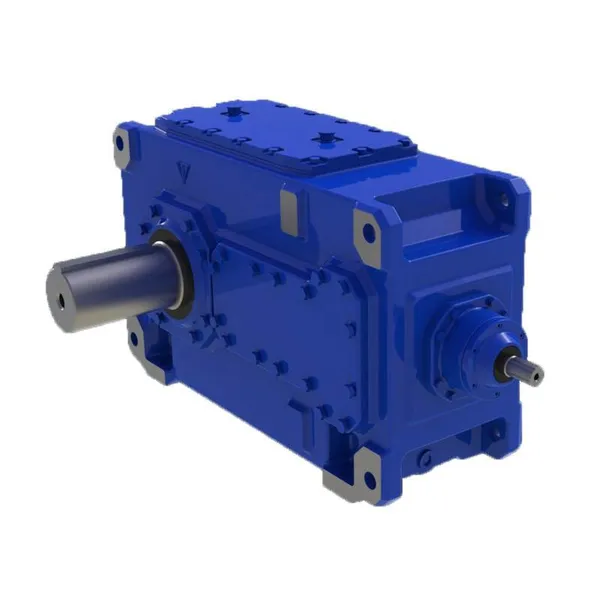
Boîte de vitesses à engrenages coniques : Fonctionnement et mécanique
Un réducteur à engrenages coniques est un dispositif mécanique conçu pour transmettre le mouvement de rotation et la puissance entre deux arbres sécants dont les axes ne sont pas parallèles. Il utilise un ensemble d'engrenages coniques pour inverser le sens de rotation de 90 degrés. Les réducteurs à engrenages coniques sont couramment utilisés dans divers systèmes et applications mécaniques nécessitant un changement de sens de rotation.
Le fonctionnement d'un réducteur à engrenages coniques peut être résumé comme suit :
- Changement de direction : Un réducteur à engrenages coniques est principalement utilisé pour rediriger le mouvement de rotation d'un arbre d'entrée vers un arbre de sortie orienté perpendiculairement. Ceci permet la transmission de puissance et de mouvement dans les virages ou entre différents plans.
- Transfert de couple : Les réducteurs à engrenages coniques sont capables de transmettre le couple entre des arbres qui se croisent, permettant ainsi un transfert efficace de la force de rotation de l'arbre d'entrée à l'arbre de sortie.
- Réduction ou augmentation de la vitesse : Selon la disposition des engrenages coniques, un réducteur à engrenages coniques peut également modifier la vitesse de rotation de l'arbre de sortie par rapport à l'arbre d'entrée. Ceci permet de réduire ou d'augmenter la vitesse selon les besoins du système mécanique.
Le fonctionnement d'un réducteur à engrenages coniques repose sur l'utilisation d'engrenages coniques, dont les dents de forme conique permettent un engrènement angulaire. Les types d'engrenages coniques les plus courants utilisés dans les réducteurs à engrenages coniques sont les engrenages coniques droits et les engrenages coniques hélicoïdaux.
Lorsque l'arbre d'entrée tourne, son engrenage conique s'engrène avec le premier engrenage conique de la boîte de vitesses. Le mouvement de rotation est ainsi transmis au second engrenage conique, monté sur l'arbre de sortie. L'engrènement de ces engrenages inverse le sens de rotation et transmet le couple à l'arbre de sortie.
On retrouve les réducteurs à engrenages coniques dans diverses applications, notamment les différentiels automobiles, les outils électriques, les presses d'imprimerie, les machines-outils et autres systèmes mécaniques où la transmission du couple et les changements de direction sont essentiels.


editor by CX 2024-02-13