
Descripción del Producto
Product Description
R series reducer is a kind of gear is used to reduce the motor speed and improve the output torque of the principle of speed reducer. It uses the gear and gear meshing, with advanced design and novel structure of retarding mechanism.
It has beenwidely used in metallurgy, mining, petroleum, chemical industry, ship, light industry, food, textile, printing and dyeing.
| Product Name | R series hard tooth flank gear reducer |
| Gear material | 20CrMnTi |
| Color | Customer Request |
| Case Material | HT250 |
| Material del eje | 20CrMnTi |
| Gear Processing | Grinding finish by HOFLER Grinding Machines |
| Noise Test | Bellow 65dB |
| Brand of bearings | C&U bearing, ZWZ,LYC, HRB,NSK ,etc |
| Brand of oil seal | NAK or other brand |
| Temp. rise (MAX) | 40ºC |
| Temp. rise (Oil)(MAX) | 50ºC |
| Vibración | ≤20µm |
Product Feature
Our R series helical gear reducers are based on the building block design, so its convenientfor them to fit all types of motors or to connect with other power input, and its possiblefor different types of machines to combine or connect.
1. Compact construction, saves space for mounting, large load-bearing capacity and long life.
2. High transmission efficiency and low noise. A single machine can reach a transmission efficiency as much as 96%.
3. Precise division of transmission ratio with a wide range. The combination of machines can produce a larger transmission ratio at a low output rotational speed.
4. Installation: Foot-mounted, B5/B14 flange-mounted, input shaft, hollow output shaft, etc.
Input power rating and permissible torque
| Tamaño | 17 | 27 | 37 | 47 | 57 | 67 | 77 | 87 | 97 | 107 | 137 | 147 | 167 | |
| Estructura | R RF | |||||||||||||
| Rated Power(kw) | 0.18-0.75 | 0.18-0.3 | 0.18-3 | 0.18-5.5 | 0.18-7.5 | 0.18-7.5 | 0.18-11 | 0.55-22 | 0.55-30 | 2.2-45 | 5.5-55 | 11-90 | 11-160 | |
| Relación | 3.83-74.84 | 3.37-135.09 | 3.33-134.82 | 3.83-176.88 | 4.39-186.89 | 4.29-199.81 | 5.21-195.24 | 5.36-246.54 | 4.49-289.74 | 5.06-249.16 | 5.15-222.60 | 5.00-163.31 | 10.24-229.71 | |
| Par motor (Nm) | 85 | 130 | 200 | 300 | 450 | 600 | 820 | 1550 | 3000 | 4300 | 8000 | 13000 | 18000 | |
| Tamaño | 37 | 57 | 67 | 77 | 87 | 97 | 107 | 127 | 157 | |
| Estructura | RX RXF | |||||||||
| Rated Power(kw) | 0.18-1.1 | 0.18-5.5 | 0.18-7.5 | 1.1-11 | 3-22 | 5.5-30 | 7.4-45 | 7.5-90 | 11-132 | |
| Relación | 1.62-4.43 | 1.3-5.5 | 1.4-6.07 | 1.42-8.00 | 1.39-8.65 | 1.42-8.23 | 1.44-6.63 | 1.51-6.2 | 1.57-6.2 | |
| Esfuerzo de torsión | 20 | 70 | 135 | 215 | 400 | 600 | 830 | 1110 | 1680 | |
| Gear Unit Weight | |||||||||||||
| Gear Unit Type | R17 | R27 | R37 | R47 | R57 | R67 | R77 | R87 | R97 | R107 | R137 | R147 | R167 |
| Weight(kg) |
4 | 5.5 | 8.5 | 10 | 18 | 25 | 36 | 63 | 101 | 153 | 220 | 400 | 700 |
| Gear Unit Type | RX37 | RX57 | RX67 | RX77 | RX87 | RX97 | RX107 | RX127 | RX157 | ||||
| Weight(kg) | 5 | 8 | 14 | 23 | 39 | 70 | 100 | 150 | 250 | ||||
| The weight are mean values, only for reference | |||||||||||||
Gear Unit Version
| Single Stage | Tamaño | |||||||||||
| 57 | 67 | 77 | 87 | 97 | 107 | |||||||
| RX.. | Montado en el pie | RX57 | RX67 | RX77 | RX87 | RX97 | RX107 | |||||
| RXF.. | Montaje con brida | RXF57 | RXF67 | RXF77 | RX87 | RX97 | RX107 | |||||
| Multi-stage | Tamaño (17/27/37/47/57/67/77/87/97/107/137/147/167) | |||||||||||
| R.. | Montado en el pie | R17 | R27 | R37 | R47 | R57 | R67 | |||||
| R..F | Foot-mounted and flange-mounted | R17F | R27F | R37F | R47F | R57F | R67F | |||||
| RF.. | B5 flange-mounted | RF17 | RF27 | RF37 | RF47 | RF57 | RF67 | |||||
| Multi-stage | Tamaño (17/27/37/47/57/67/77/87/97/107/137/147/167) | ||||||
| R.. | R77 | R87 | R97 | R107 | R137 | R147 | R167 |
| R..F | R77F | R87F | R97F | R107F | R137F | R147F | R167F |
| RF.. | RF77 | RF87 | RF97 | RF107 | RF137 | RF147 | RF167 |
Product Application
Packing & Shipping
/* January 22, 2571 19:08:37 */!function(){function s(e,r){var a,o={};try{e&&e.split(“,”).forEach(function(e,t){e&&(a=e.match(/(.*?):(.*)$/))&&1
| Application: | Motor, Electric Cars, Motorcycle, Machinery, Marine, Toy, Car, Factories |
|---|---|
| Hardness: | Hardened Tooth Surface |
| Installation: | as Request |
| Layout: | Helical Inline |
| Step: | Three-Step |
| Tipo: | Engranaje cónico |
| Customization: |
Available
| Customized Request |
|---|
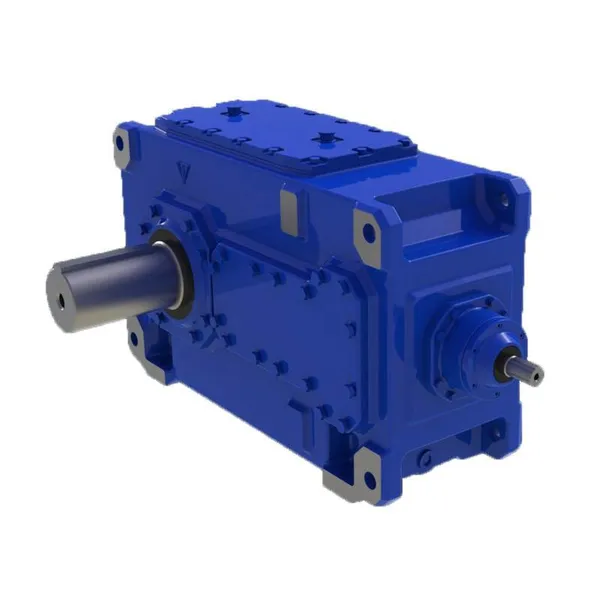
Minimizing Backlash and Ensuring Efficient Power Transfer in Bevel Gearboxes
Bevel gearboxes are meticulously designed to minimize backlash and optimize power transfer efficiency, ensuring smooth and precise motion in mechanical systems.
Several design considerations contribute to minimizing backlash and enhancing power transfer:
- Tooth Profile and Quality: High-precision tooth profiles with minimal clearance between mating gears reduce backlash. The use of advanced manufacturing techniques ensures consistent gear quality and accurate tooth engagement.
- Preload and Contact Pattern: Properly applied preload and optimized contact patterns between the bevel gear teeth enhance meshing accuracy, reducing the potential for backlash and improving load distribution.
- Gearbox Rigidity: Stiff and rigid gearbox housing and components help maintain precise gear alignment, reducing the effects of deflection and misalignment that can lead to backlash.
- Bearing Selection: High-quality bearings with minimal play contribute to reduced backlash and smoother motion by minimizing axial and radial movement of the gears.
- Lubrication: Adequate lubrication reduces friction, wear, and vibration, promoting efficient power transfer and minimizing backlash-related issues.
- Tolerances and Manufacturing Precision: Tight manufacturing tolerances and precision machining processes ensure consistent gear geometry, alignment, and positioning, minimizing any potential sources of backlash.
By incorporating these design principles and practices, bevel gearboxes are engineered to achieve tight backlash control and efficient power transmission. This makes them suitable for applications where precise motion control, accuracy, and reliability are crucial, such as robotics, aerospace, automotive, and industrial machinery.
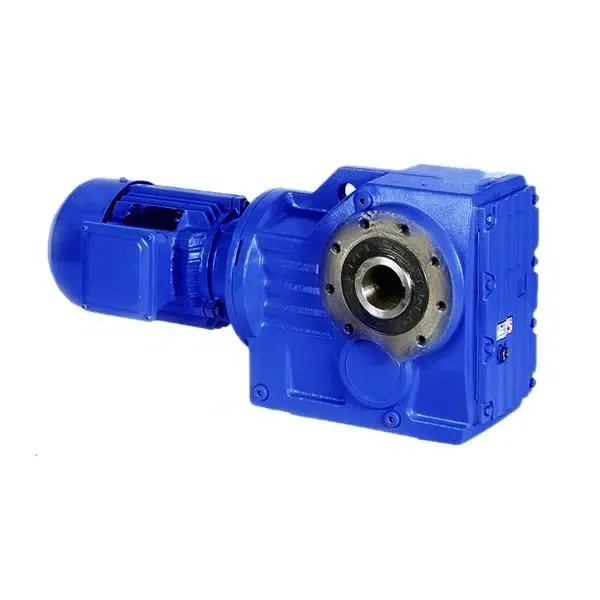
Challenges of Using Bevel Gearboxes
While bevel gearboxes offer various benefits, there are certain challenges that can arise when using them:
- Lubrication: Proper lubrication is essential to reduce friction, wear, and heat generation in bevel gearboxes. However, ensuring effective lubrication in the meshing bevel gears can be challenging due to their complex geometry and the potential for oil pooling or inadequate coverage.
- Noise and Vibration: Bevel gearboxes can produce noise and vibration during operation, especially at higher speeds. The interaction of the gear teeth can lead to noise generation, which may require additional measures such as sound insulation or vibration dampening to mitigate.
- Alignment: Precise alignment of the bevel gears is crucial to ensure smooth and efficient power transmission. Misalignment can lead to increased wear, reduced efficiency, and even gear tooth failure. Achieving proper alignment can be more complex in bevel gearboxes compared to other gearbox types.
- Maintenance: Bevel gearboxes may require more frequent maintenance compared to other gear systems. Regular inspections, lubrication checks, and gear tooth profile monitoring are necessary to detect and address any issues before they escalate.
- Restricciones de espacio: The design of bevel gearboxes can be bulky, especially when used in applications that require a high gear ratio. This can pose challenges in situations where space is limited.
- Heat Dissipation: High-speed or heavy-duty applications can generate significant heat in bevel gearboxes. Adequate heat dissipation mechanisms, such as cooling fins or lubrication cooling, may be required to prevent overheating and premature failure.
Engineers and manufacturers need to carefully address these challenges to ensure the reliable and effective use of bevel gearboxes in various applications.
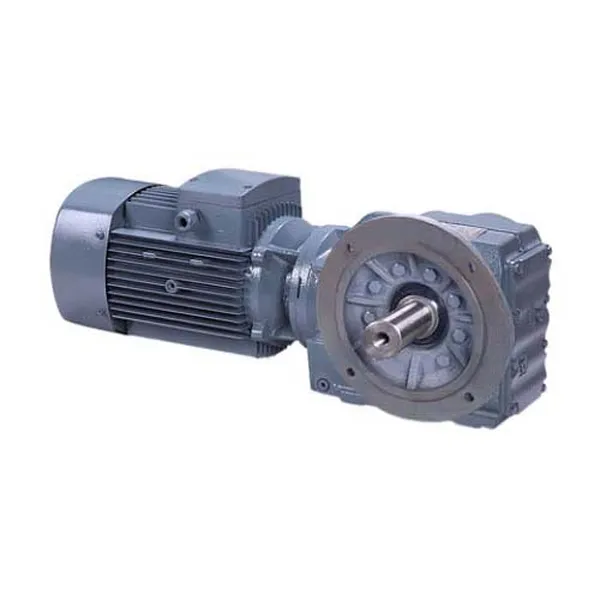
Transmission of Motion at an Angle with Bevel Gearboxes
Bevel gearboxes are designed to transmit motion between intersecting shafts that are positioned at an angle to each other. They accomplish this by using a set of bevel gears, which have teeth that are cut in a conical shape.
When two bevel gears mesh, their teeth engage at the point of contact. As one gear rotates, it drives the other gear, transmitting motion and torque between the shafts. The angle between the shafts and the orientation of the gear teeth determine the direction and speed of motion transfer.
There are two main types of bevel gears commonly used in bevel gearboxes:
- Straight Bevel Gears: These gears have straight-cut teeth and are used when the intersecting shafts are at a 90-degree angle. They are the simplest form of bevel gears and provide efficient motion transmission.
- Spiral Bevel Gears: These gears have teeth that are cut at an angle, allowing them to gradually engage and disengage. Spiral bevel gears are used when the intersecting shafts are at angles other than 90 degrees. They provide smoother operation, less noise, and increased load-carrying capacity compared to straight bevel gears.
The precision manufacturing of bevel gear teeth ensures accurate and reliable motion transmission at various angles, making bevel gearboxes suitable for applications that require motion to be transferred between intersecting shafts in non-parallel orientations.


editor by CX 2024-04-08