
In high-speed industrial drive specification, two gear unit families frequently appear on the shortlist side by side: the helical bevel gearbox and the roda gigi bevel spiral. Both deliver excellent efficiency, quiet operation, and reliable service life. But they are engineered with fundamentally different design philosophies — and choosing the wrong one for your application results in unnecessary cost, complexity, or performance compromise.
1. What Is a Helical Bevel Gearbox?
A helical bevel gearbox — sometimes called a bevel-helical gearbox — combines a bevel gear stage (which performs the 90-degree direction change) with one or more helical gear stages (which provide the majority of the speed reduction). The bevel stage is typically a straight or spiral bevel set operating at relatively low torque; the helical stages downstream handle the bulk of the reduction at higher torque and lower speed.
This multi-stage architecture allows helical bevel gearboxes to achieve very high reduction ratios in a single housing — commonly up to 45:1 in a two-stage bevel-helical unit, or up to 200:1 in three-stage configurations — while maintaining good overall efficiency because the helical stages are highly efficient in their own right.
2. What Is a Spiral Bevel Gearbox?
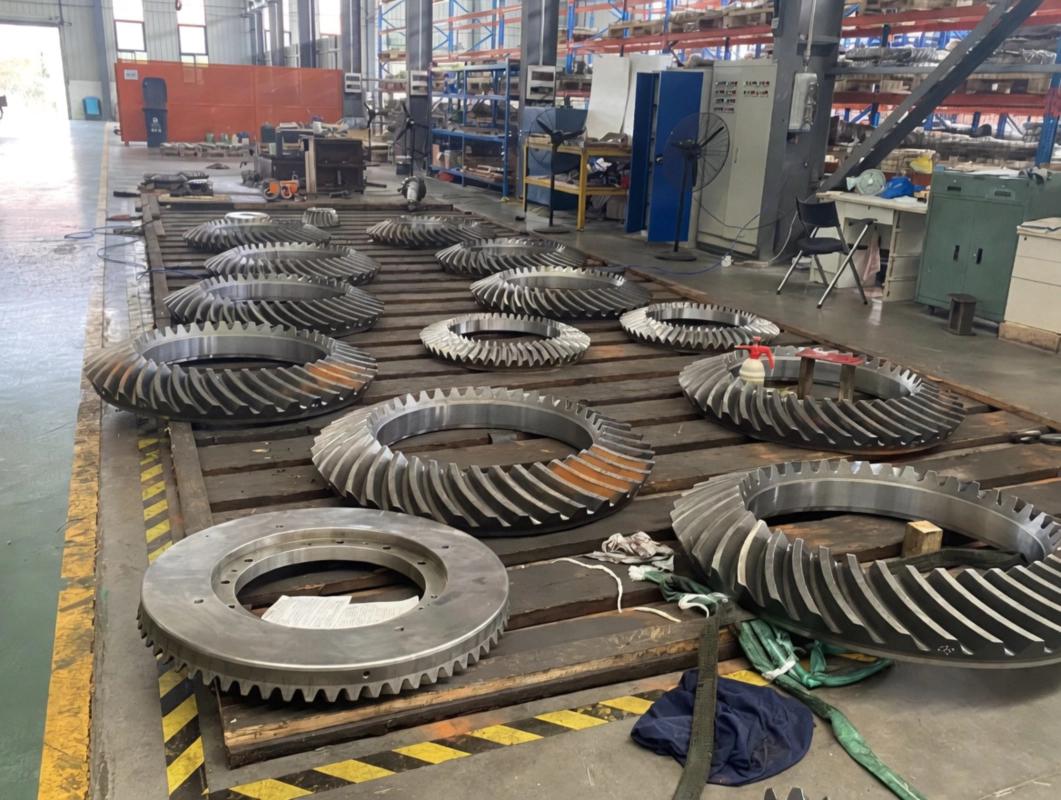
A roda gigi bevel spiral is a single-stage unit using a matched pair of precision-ground spiral bevel gears to deliver 90-degree power redirection with or without speed reduction. Standard ratios run from 1:1 to 3:1 in the industrial range, with extended ratios up to 6:1 available. The single-stage design means the unit is compact, mechanically simple, and operates at maximum efficiency because there is only one gear mesh in the power path.
Ever Power spiral bevel gearboxes achieve 94–96% transmission efficiency as a single-stage unit. At 1:1 ratio — pure direction change with no speed reduction — they are the most efficient right-angle drive available.
3. Head-to-Head Comparison
| Parameter | Kotak Gigi Bevel Spiral | Helical Bevel Gearbox |
|---|---|---|
| Gear Stages | Single stage | 2–3 stages (bevel + helical) |
| Typical Ratio Range | 1:1 – 6:1 | 5:1 – 200:1 |
| Single-Stage Efficiency | 94% – 96% | 90% – 95% (cumulative multi-stage) |
| Noise Level | 60 – 68 dB | 62 – 72 dB (multi-stage) |
| Physical Size | Compact — single housing | Larger — multiple gear sets |
| Mechanical Complexity | Low — single gear mesh | Higher — multiple shafts and bearings |
| Best Ratio Range | 1:1 – 3:1 (optimal) | 10:1 – 45:1 (optimal) |
| Shaft Arrangement Options | 1, 2 or 3 output shafts | Typically single output |
| Maintenance Points | Minimal — single oil sump | More bearings, longer inspection routes |

4. High-Speed Applications: Which Wins?
For high input speed with moderate reduction (1:1 to 6:1), the roda gigi bevel spiral is the clear winner. A single precision gear mesh at high speed generates less noise and heat than a multi-stage arrangement, and the spiral tooth geometry handles high pitch line velocities up to 25 m/s without difficulty. Direct motor coupling at 1,450 or 3,000 rpm to a spiral bevel gearbox is standard practice in industrial drives.
For high input speed with high reduction (10:1 and above), a helical bevel gearbox becomes relevant. The bevel stage handles the 90-degree direction change at the input speed, then the helical stages provide the bulk of the reduction at progressively lower speeds and higher torques where helical gears operate most efficiently.
The decision boundary is roughly at a ratio of 5:1 to 6:1 — below this, spiral bevel single stage; above this, helical bevel multi-stage becomes more practical and cost-effective.
5. Efficiency Across the Ratio Range
The efficiency comparison changes with ratio. At low ratios (1:1 to 3:1), the spiral bevel single stage consistently outperforms the helical bevel multi-stage because each additional gear mesh stage adds 1–2% friction loss. At 1:1 ratio, a spiral bevel gearbox at 96% efficiency is difficult to match with any multi-stage arrangement.
At higher ratios (20:1 and above), the helical bevel multi-stage achieves better overall efficiency than a spiral bevel plus separate inline reducer arrangement, because the integrated design shares a common oil sump and the gear mesh geometry is optimised for the actual load distribution at each stage.
6. The Multi-Output Advantage of Spiral Bevel
One capability that helical bevel gearboxes cannot replicate is the spiral bevel multi-output shaft arrangement. Ever Power spiral bevel gearboxes are available in B (2-shaft), C (3-shaft), and D (4-shaft) configurations, allowing a single input to simultaneously drive two or three output axes. This is invaluable in stage machinery, twin-shaft conveyors, and agricultural drives where multiple implements must be powered from one PTO connection.
Helical bevel gearboxes are fundamentally single-input, single-output designs. Multi-output capability requires external shaft splitters or additional gear units — adding complexity and cost.
7. Customer Cases
Denmark — Cooling Tower OEM
Fan drives required 2:1 right-angle reduction from a 1,450 rpm motor. Specified Ever Power spiral bevel gearboxes. The single-stage efficiency at 2:1 ratio was measurably better than the helical bevel alternative evaluated — and the unit was 22% lighter, simplifying the fan nacelle structure.
“At 2:1 ratio, there is no justification for multi-stage complexity.” — Mechanical Design Engineer
Austria — Stage Machinery
A theater fly system required simultaneous drive to two winch drums from one motor. The C-configuration (3-shaft) spiral bevel gearbox from Ever Power provided dual output inherently — no helical bevel unit could do this without additional external components.
“The dual-output capability was the deciding factor. Nothing else came close.” — Stage Machinery Project Manager
USA — Conveyor Drive, Ohio
At 3:1 ratio for a conveyor head pulley, the OEM evaluated both helical bevel and spiral bevel options. Ever Power spiral bevel was selected: 96% efficiency vs 93% for the helical bevel alternative, simpler maintenance, and a 28% lower unit cost per drive station.
“Simple, efficient, and priced right. That is what our customers want.” — OEM Engineering Manager
FAQ
Not sure which gearbox is right for your high-speed drive?
Submit your motor data, required ratio, and installation details. Ever Power engineers will recommend the optimal spiral bevel or bevel-helical solution within 24 hours.