
When specifying a right-angle gear drive, the choice between a spiral bevel gear and a straight bevel gear appears straightforward but carries major consequences for noise, longevity, load capacity, and operating cost. This technical guide covers every critical difference with engineering data, so you can select the correct bevel gear geometry with confidence.
1. Tooth Geometry: The Root of Every Performance Difference
A straight bevel gear has teeth that run straight along the pitch cone surface. Each tooth makes instantaneous full-face contact as it enters the mesh — an abrupt engagement that generates impact at every tooth pass frequency.
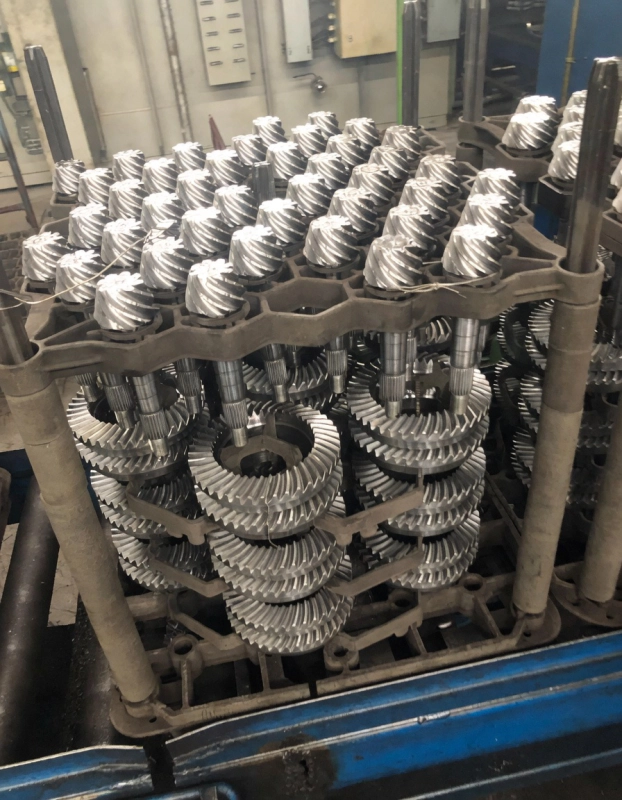
A spiral bevel gear has teeth curved at a spiral angle of typically 30–35 degrees. Contact begins at one end of the tooth and sweeps progressively across the face width. This gradual engagement is the source of every performance advantage spiral bevel holds over straight bevel — in noise, load capacity, speed capability, and service life.
Contact ratio in spiral bevel gears typically reaches 1.5–2.5, compared to 1.2–1.5 for straight bevel gears. A higher contact ratio means more teeth share the load at any given instant, reducing peak tooth stress.
2. Technical Comparison Table
| Parameter | Spiral Bevel Gear | Straight Bevel Gear |
|---|---|---|
| Contact Ratio | 1.5 – 2.5 | 1.2 – 1.5 |
| Noise Level | 60 – 68 dB | 75 – 90 dB |
| Load Capacity vs Straight | +20 – 30% higher | Baseline |
| Max Pitch Line Speed | Up to 25 m/s | Below 5 m/s recommended |
| Vibration | Below 20 um | Higher — impact at engagement |
| Axial Thrust | Significant — needs thrust bearings | Moderate |
| Manufacturing Process | Gleason / Klingelnberg + grinding | Hobbing or milling |
| Gear Material (Ever Power) | 20CrMnTi, HRC 58–62 surface | 20CrMnTi or mild alloy |
| Best Applications | High-speed, heavy-duty, continuous | Low-speed, light-duty, intermittent |
3. The Noise Advantage: 40–60% Quieter in Measured Tests
Noise in a gear drive originates from the impact of tooth engagement. Straight bevel gears engage across the full tooth width instantaneously, generating a percussive impact at every tooth pass frequency. At 1,450 rpm input with 20 teeth, that is 483 tooth engagements per second — each one an impact event.
Spiral bevel gears eliminate this impact entirely. The progressive swept contact of the spiral tooth means force builds gradually across the tooth face and releases gradually. Laboratory and field measurements consistently show a 40–60% noise reduction compared to equivalent straight bevel designs under the same load and speed conditions.
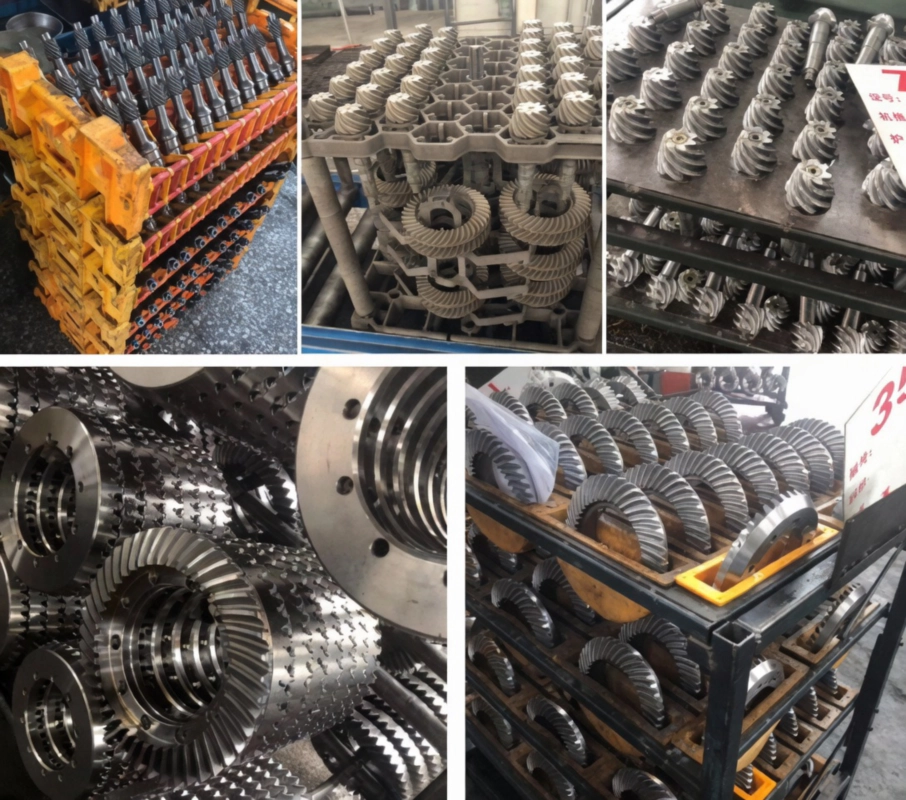
Ever Power spiral bevel gearboxes are precision-ground to ISO Grade 5–6, achieving a maximum measured noise level of 60–68 dB — making them suitable for food processing halls, pharmaceutical manufacturing, packaging lines, and stage machinery where straight bevel noise levels would be operationally or legally unacceptable.
4. Load Capacity: Why Contact Ratio Is the Critical Number
A higher contact ratio means more teeth share the applied torque simultaneously. For spiral bevel gears with a contact ratio of 2.0, each tooth carries approximately half the torque it would bear as the sole tooth in contact. This distribution of Hertzian contact stress across a larger area reduces fatigue risk and allows a spiral bevel gearbox of equivalent physical size to handle 20–30% higher loads than a straight bevel design.
This capacity advantage means that for a given output torque requirement, a smaller spiral bevel unit can often be specified — partially offsetting its higher manufacturing cost while delivering superior noise and speed performance.
5. Speed Limits: Where Straight Bevel Cannot Compete
Straight bevel gears are limited to pitch line velocities below 5 m/s. Beyond this, the instantaneous engagement impact generates vibration, surface fatigue, and noise at levels that are destructive to gear life and unacceptable for the operating environment. For a 200 mm pitch diameter gear at 1,450 rpm, pitch line velocity is already 15.2 m/s — well beyond the straight bevel practical limit.
Spiral bevel gears operate reliably at pitch line velocities up to 25 m/s, making them the standard choice for helicopter transmissions, high-speed industrial drives, printing presses, and precision automation equipment.
6. Material Standards: How Ever Power Achieves ISO Grade 5–6
Carburized to 1.0–1.6 mm case depth, quenched in controlled atmosphere, precision ground to HRC 58–62 surface hardness. Tough core maintained at HRC 33–40 to resist shock fracture.
Normalized and tempered to HRC 25–30. Precision-ground journals provide a tight interference fit with tapered roller bearings for controlled backlash and long bearing life.
FEA-optimised ribbed casting bored in a single setup to ensure bearing bore perpendicularity within 0.02 mm — essential for correct spiral bevel gear mesh geometry.
7. Quick Decision Guide
| Application Condition | Recommended Gear Type |
|---|---|
| Input speed above 1,000 rpm | सर्पिल बेवल |
| Continuous duty 16+ hours per day | सर्पिल बेवल |
| Noise limit below 70 dB | सर्पिल बेवल |
| Servo or positioning drive | सर्पिल बेवल |
| Low speed, light load, intermittent | Straight Bevel acceptable |
| Absolute minimum first cost only | Straight Bevel may be considered |

8. Customer Experiences
Belgium — Textile Machinery OEM
Switched from straight bevel units to Ever Power spiral bevel gearboxes on a multi-spindle weaving machine. Noise fell from 82 dB to 63 dB and vibration-related bearing failures dropped from four per year to zero across 24 months.
“The difference in smoothness was immediately obvious on the first test run.” — Machine Design Engineer
Poland — Agricultural Equipment Manufacturer
Replaced straight bevel steering boxes on harvester PTO drives with Ever Power spiral bevel units. PTO vibration transmitted to the operator cab fell by 30% and gear service life extended by 40% at equivalent operating hours.
“Warranty claim rate on the drive train dropped significantly after we switched.” — R&D Engineer
USA — Printing Equipment Manufacturer
Print head drives at 3,000 rpm input could not use straight bevel — vibration caused registration errors. Ever Power spiral bevel units resolved the registration issue completely and cut drive noise to below the floor specification.
“No other gear type could handle our speed and noise target simultaneously.” — Technical Director
FAQ
Need a custom spiral bevel gearbox for your application?
Ever Power designs and manufactures precision spiral bevel gearboxes to your exact specification, with CE documentation and global delivery from our Netherlands-registered company.