The performance of a علبة تروس مخروطية حلزونية over its service life is determined not only by its geometric design but by the material properties of every load-bearing component. The selection of gear steel alloy, heat treatment process, carburizing depth, shaft material, and housing iron grade are engineering decisions with direct consequences for load capacity, fatigue life, shock resistance, and maintenance intervals. This guide explains every material specification used in Ever Power spiral bevel gearboxes — what each material is, why it was selected, and what it delivers in service.
1. Gear Material: 20CrMnTi Alloy Steel
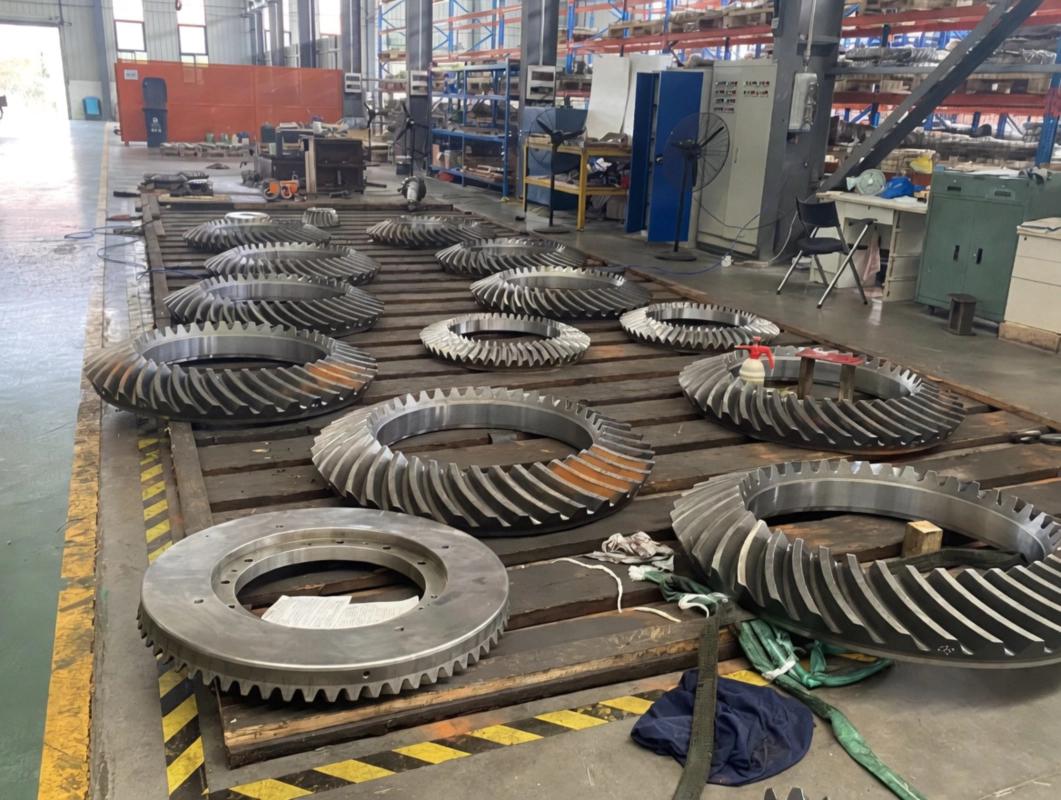
The spiral bevel gear sets in all Ever Power gearboxes are manufactured from 20CrMnTi — a Chinese national standard (GB/T 3077) carburizing alloy steel that corresponds closely to 16MnCr5 (DIN/EN), SAE 5120, and JIS SCM415 in terms of composition and properties. The material contains chromium (1.0–1.3%), manganese (0.8–1.1%), and titanium (0.04–0.10%) as key alloying elements, with a base carbon content of 0.17–0.23%.
Why 20CrMnTi for spiral bevel gears?
The low base carbon content (0.17–0.23%) allows the core of the gear to remain tough and ductile after heat treatment — essential for absorbing the impact loads that occur during belt conveyor starts, agricultural PTO engagement, and mining lump ore loading. The alloy additions enable the surface to be carburized to high hardness, giving the tooth face the wear resistance needed for millions of mesh cycles in service.
| Property | Value | Engineering Significance |
|---|---|---|
| Surface Hardness (after carburizing + quenching) | HRC 58 – 62 | High contact fatigue resistance; resists pitting and spalling |
| Core Hardness | HRC 33 – 40 | Tough core absorbs bending impact without brittle fracture |
| Carburized Case Depth (standard) | 1.0 – 1.4 mm | Sufficient case depth to survive contact fatigue at rated load |
| Carburized Case Depth (heavy duty) | 1.2 – 1.6 mm | Deeper case for mining and heavy shock applications |
| Tensile Strength (core, after treatment) | 900 – 1,100 MPa | High core strength supports gear tooth root bending capacity |
| Approximate International Equivalents | 16MnCr5 (DIN), SAE 5120, JIS SCM415 | Globally recognised carburizing steel; established performance data |
| Gear Precision Grade (after grinding) | ISO Grade 5 – 6 | Precision profile enables 60 – 68 dB noise level and high contact ratio |
2. The Heat Treatment Process: Carburizing, Quenching and Grinding
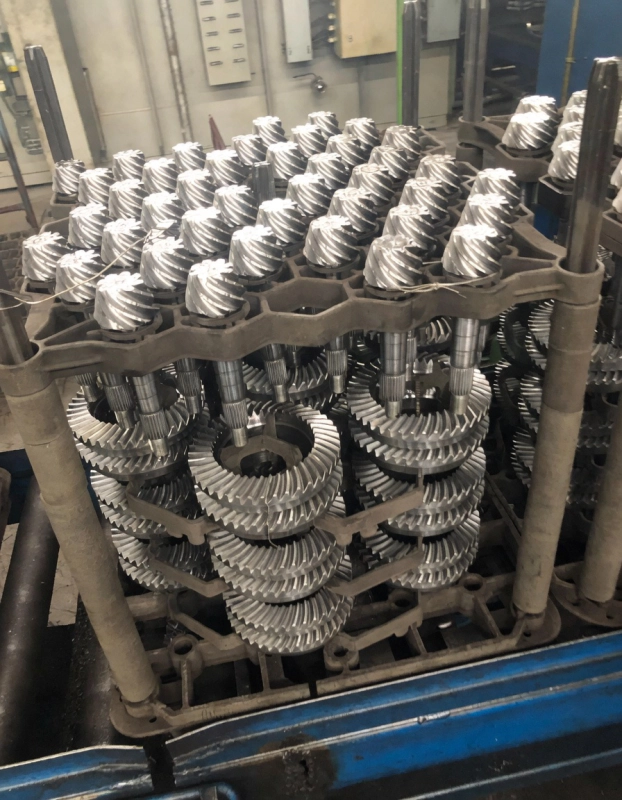
The transformation of a 20CrMnTi steel blank into a precision spiral bevel gear involves a defined sequence of heat treatment steps that must be controlled precisely to achieve the target surface and core hardness combination:
The rough-machined gear is placed in a controlled carbon-rich atmosphere at 900–950°C. Carbon diffuses from the atmosphere into the steel surface, raising the surface carbon content from 0.20% to 0.80–1.0% to a depth of 1.0–1.6 mm. The core carbon content remains unchanged.
The carburized gear is quenched in oil at 60–80°C. The high surface carbon content transforms to martensite at HRC 58–62. The low core carbon content transforms to a mixture of ferrite and bainite at HRC 33–40. Controlled atmosphere quenching prevents oxidation of the carburized surface.
After quenching, the gear is tempered to relieve quench stresses and improve toughness of the martensite surface layer without significantly reducing hardness. Surface hardness after tempering: HRC 58–62 (unchanged). Brittleness of as-quenched martensite is reduced.
Heat treatment introduces distortion in the gear tooth geometry. Precision grinding on a Gleason or Klingelnberg machine removes this distortion, correcting the tooth profile back to within ISO Grade 5–6 tolerance (pitch error below 6 microns, profile error below 8 microns).
3. Shaft Material: 42CrMo Alloy Steel
42CrMo (GB/T 3077) is a medium-carbon chromium-molybdenum alloy steel, broadly equivalent to 42CrMo4 (EN 10083-3), SAE 4140, and JIS SCM440. It contains 0.38–0.45% carbon, 0.9–1.2% chromium, and 0.15–0.25% molybdenum, providing a combination of high hardenability, good toughness, and excellent fatigue resistance.
Ever Power uses 42CrMo for input and output shafts, normalized and tempered to HRC 25–30 through-hardness — not just surface hardened. Through-hardening means the full shaft cross-section is at the target hardness level, not just a surface layer. This is critical for shafts carrying combined bending and torsional loads, where bending fatigue initiates from the surface but propagates through the material cross-section.
| Property | 42CrMo (HRC 25–30) | Significance |
|---|---|---|
| Tensile Strength | 900 – 1,100 MPa | High shaft strength; resists torsional overload |
| Yield Strength | 750 – 950 MPa | Conservative safety factor on yielding at rated torque |
| Fatigue Limit (rotating bending) | Approx. 420 – 500 MPa | Long fatigue life under continuous cyclic bending from belt pull forces |
| Impact Toughness (Charpy) | 60 – 100 J | Absorbs shock without brittle fracture — critical for mining and agricultural drives |
| International Equivalent | 42CrMo4 (EN), SAE 4140, JIS SCM440 | Globally recognised and specified alloy |
| Machinability | Good (65% of free-cutting steel) | Allows precision-ground journal finish for bearing fit |
4. Housing Material: Cast Iron vs Ductile Iron
The gearbox housing carries the gear mesh separation forces and provides the rigid structure that maintains shaft alignment under load. Ever Power offers two housing material options with different performance profiles:
Standard housing material for general industrial applications. Excellent machinability, good vibration damping (graphite flakes in the microstructure absorb vibration energy), adequate compressive strength. Elongation at fracture: 0.5–1% — meaning grey iron shatters under extreme shock rather than deforming. Standard service factor up to 1.75.
Nodular graphite microstructure gives elongation at fracture of 5–15% — the housing deforms before it fractures under shock. Tensile strength 500 MPa vs 200–300 MPa for grey iron. Specified for mining conveyors, agricultural PTO drives, forestry equipment, and any application with service factor above 2.0 or shock loads above 3x nominal torque.
5. Sealing Materials: NBR vs FKM
| Seal Material | Temperature Range | Oil Compatibility | When to Specify |
|---|---|---|---|
| NBR (Nitrile) | -30°C to +120°C | Mineral and GL-4 EP oils | Standard industrial; mineral oil; operating temp below 100°C |
| FKM (Viton) | -20°C to +200°C | Synthetic PAO, esters, GL-5 hypoid | Synthetic oil; high temperature; chemical environments; mining duty |
| PTFE lip seal | -60°C to +260°C | Universal — all lubricants | Extreme temperature; aggressive chemicals; very high shaft speed |
6. Material Certificates and Documentation
Ever Power provides material documentation at three levels depending on application requirement:
- Standard (included with all units): Quality inspection report confirming material grade, hardness measurements, and dimensional checks
- EN 10204 Type 2.2 (on request): Works certificate confirming compliance with material specification, based on production batch testing
- EN 10204 Type 3.1 (on request, additional cost): Inspection certificate with test results from an authorised inspection representative — required for mining, offshore, and pressure equipment applications
Specify the required documentation level at time of order. Type 3.1 certificates require advance notice of minimum 5 working days to arrange the inspection authority’s involvement in the manufacturing process.
Customer Cases
Norway — Offshore Platform Equipment
Marine-specification spiral bevel gearboxes required EN 10204 3.1 material certificates for the gear steel and shaft material. Ever Power arranged third-party inspection authority involvement during manufacturing and delivered the full 3.1 certificate package within the project timeline. “No other supplier we approached could provide 3.1 certificates within our delivery window.” — Procurement Specialist, Stavanger
Saudi Arabia — Petrochemical Plant
Replacement gearbox specification required 42CrMo shaft material confirmed by mill certificate — the previous supplier had used a lower-alloy shaft that corroded in the H2S-containing atmosphere. Ever Power provided the 42CrMo mill certificate and FKM seals as standard. “The certificate and the correct seal material were non-negotiable. Ever Power understood immediately.” — Plant Maintenance Engineer
Germany — Automotive Test Facility
A drive test rig required documented gear material hardness measurements for a validation protocol. Ever Power provided individual hardness test results per unit — surface HRC and core HRC measured at defined locations per a specified test plan. “The traceability of material data per unit serial number is what we needed for our validation records.” — Test Facility Engineer, Stuttgart
FAQ
Need full material documentation for your spiral bevel gearbox order?
Ever Power provides material certificates from standard QC reports through EN 10204 3.1 third-party inspection certificates. CE certified, Netherlands-registered, global delivery.