
The เกียร์เฟืองเฉียงเกลียว and the hypoid gearbox look strikingly similar from the outside — both use curved bevel gear teeth and both change drive direction by 90 degrees. Yet beneath that visual similarity lie fundamental differences in shaft geometry, efficiency, lubrication requirements, and the type of applications each serves best. For engineers specifying right-angle drive systems, understanding these differences prevents costly misapplication.
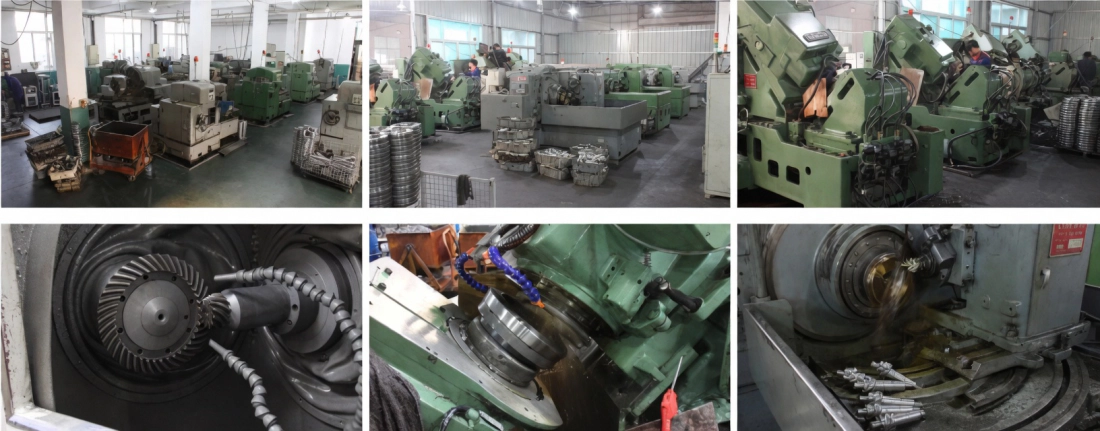
1. The Defining Difference: Shaft Intersection vs Shaft Offset
In a เกียร์เฟืองเฉียงเกลียว, the axes of the input and output shafts intersect — they cross at a single point (the apex of the pitch cone). This is the classical bevel gear geometry dating back to the earliest right-angle drives.
In a hypoid gearbox, the axes do not intersect — the pinion axis is offset from the gear axis by a distance called the hypoid offset, typically 25–50 mm in industrial designs. This offset changes the fundamental kinematics of the gear mesh from predominantly rolling contact (spiral bevel) to a combination of rolling and significant longitudinal sliding along the tooth face (hypoid).
That shift from rolling to sliding contact is the origin of every technical difference between the two gear types.
2. Technical Comparison: Spiral Bevel vs Hypoid
| Parameter | เกียร์เฟืองเฉียงเกลียว | Hypoid Gearbox |
|---|---|---|
| Shaft Geometry | Intersecting axes | Offset axes (non-intersecting) |
| Contact Type | Predominantly rolling | Rolling + significant sliding |
| Transmission Efficiency | 94% – 96% | 90% – 94% (sliding losses) |
| Torque Capacity vs Size | High | Up to 1.5x higher (offset effect) |
| Lubrication Requirement | Standard EP gear oil (GL-4) | High-pressure GL-5 hypoid oil mandatory |
| Heat Generation | Low | Higher — sliding friction |
| Noise Level | 60 – 68 dB | Very low — sliding damps noise |
| Shaft Position Flexibility | Fixed — shafts must intersect | Flexible — offset allows lower driveline |
| Manufacturing Complexity | High (Gleason/Klingelnberg) | Very high |
| Primary Industry | General industrial drives | Automotive differentials, heavy axles |
3. Efficiency: Why the Sliding Contact Matters
In a spiral bevel gear mesh, the dominant motion is rolling — the tooth surfaces roll across each other much like a cylinder on a flat surface. Friction losses are low because rolling resistance is inherently low. The result is 94–96% transmission efficiency.
In a hypoid gear mesh, the offset between shaft axes introduces substantial longitudinal sliding along the tooth face. Sliding generates significantly more friction than rolling, which translates directly into heat and efficiency loss. Hypoid gearboxes typically achieve 90–94% efficiency — lower than spiral bevel, and requiring higher-specification lubrication to manage the sliding interface temperature and prevent scuffing.
For continuous industrial duty — conveyors, fans, mixers, pumps running thousands of hours per year — this 2–6% efficiency difference accumulates into measurable energy cost over the unit’s service life.

4. Lubrication: A Critical Differentiator
Spiral bevel gearboxes operate successfully with standard extreme-pressure (EP) gear oils, grade GL-4 or equivalent — widely available, affordable, and compatible with most standard seal materials including NBR and FKM.
Hypoid gearboxes require GL-5 hypoid gear oil, specifically formulated with sulphur-phosphorus extreme-pressure additives to manage the high sliding velocities and contact pressures at the tooth interface. GL-5 oils are more expensive, less widely stocked, and — critically — can attack yellow metal components including bronze bushings and brass fittings that may be present in other parts of the machinery.
In industrial environments where multiple machines share a lubricant specification, the mandatory GL-5 requirement of a hypoid drive can create logistics complexity and contamination risk if standard GL-4 oil is accidentally used during maintenance.
5. Torque Capacity and the Offset Advantage
The hypoid offset allows a larger pinion diameter for a given gear ratio, because the pinion does not need to fit geometrically between the gear cone apex and the housing wall. A larger pinion means more tooth contact area, which translates into up to 1.5x higher torque capacity from a physically comparable unit size compared to a spiral bevel equivalent.
This torque density advantage is why hypoid gears dominate automotive rear axle differentials — where packaging space is severely constrained and maximum torque transfer is required. For most industrial spiral bevel gearbox applications, the standard torque capacity of the spiral bevel design is entirely sufficient, and the efficiency and lubrication advantages of spiral bevel are preferred.
6. Application Match: Which Drive for Which Industry
- General industrial drives — conveyors, fans, pumps, mixers
- Agricultural and construction machinery
- Stage machinery and entertainment drives
- Mining, metallurgy, chemical processing
- Food processing and pharmaceutical (GL-4 lubricant compatibility)
- Any application requiring 94%+ efficiency
- Automotive rear axle differentials
- Heavy truck and bus axles
- Applications where shaft offset is a geometric necessity
- Maximum torque density in severely space-constrained installations
- Applications where GL-5 lubrication logistics are manageable
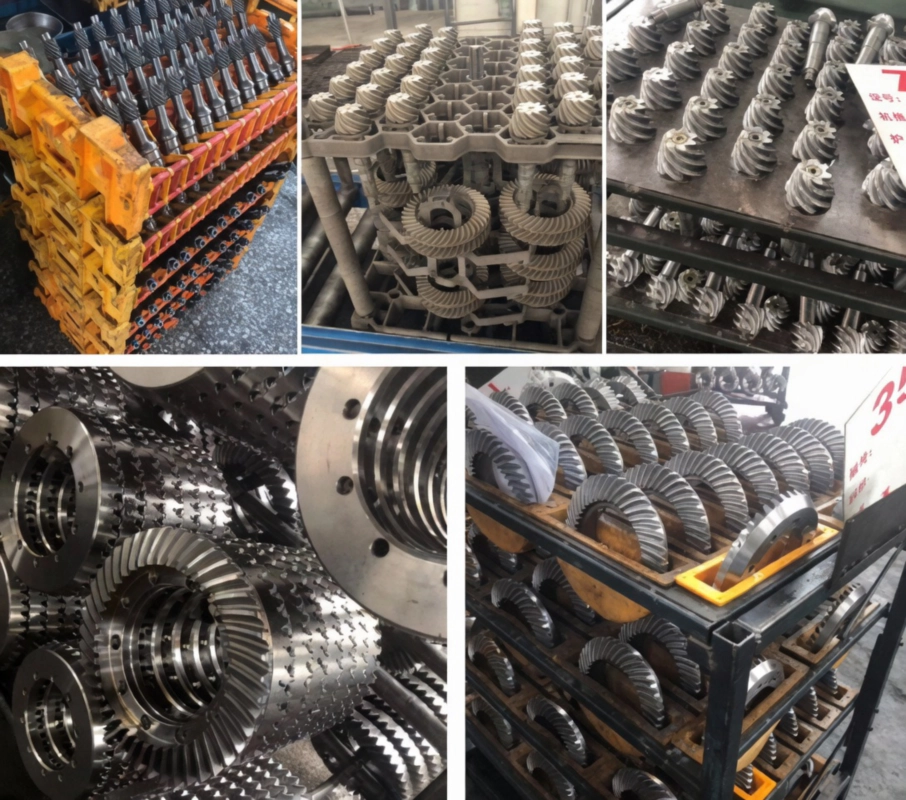
7. Ever Power Custom Spiral Bevel Gearboxes
Ever Power specialises in custom and standard spiral bevel gearboxes for industrial customers worldwide. As a Netherlands-registered company with precision manufacturing in China, we combine European commercial standards with competitive pricing and fast lead times.
Our custom design capability covers non-standard ratios, special shaft configurations, extreme-environment sealing, and tailored housing dimensions based on your installation drawing. Every custom unit is supplied with CE declaration, ISO 9001 quality documentation, and a load test certificate.
8. Customer Cases
Netherlands — Chemical Plant, Rotterdam
Replaced hypoid units on three agitator drives with Ever Power spiral bevel gearboxes. GL-5 oil handling was creating maintenance complexity — switch to GL-4 compatible spiral bevel simplified the lubrication schedule and eliminated two annual oil analysis checks.
“Simpler maintenance and better efficiency. The decision was straightforward once we ran the numbers.” — Maintenance Manager
Sweden — Paper Mill Drive
Specified Ever Power custom spiral bevel units for a new paper machine section drive. Intersecting shaft geometry allowed simpler housing design than the hypoid alternative, reducing total drive train cost by 18%.
“Ever Power provided CAD models within 48 hours of receiving our specification. Excellent engineering support.” — Project Engineer
India — Cement Plant, Rajasthan
Heavy-duty spiral bevel gearboxes installed on kiln auxiliary drives. High ambient temperatures (48°C) made the lower heat generation of spiral bevel gearboxes essential — hypoid units had been running above their thermal limits on the previous installation.
“Oil temperature stayed within limit throughout the summer months. The switch was the right call.” — Plant Mechanical Engineer
FAQ
Specifying a right-angle gearbox for your industrial drive?
Ever Power engineers will assess your requirements and recommend the optimal spiral bevel solution — with drawings, CE documentation, and a competitive quotation within 48 hours.