
The noise reduction of spiral bevel gears over straight bevel gears — consistently measured at 40–60% in controlled comparisons — is not a marketing claim. It is a predictable engineering outcome rooted in tooth geometry, contact mechanics, and the physics of vibration generation. This guide explains the precise mechanisms behind the noise reduction: what generates noise in a gear drive, why straight bevel gears are noisy, and exactly how the spiral tooth form eliminates those noise sources — with the quantitative detail that noise-sensitive application engineers need.
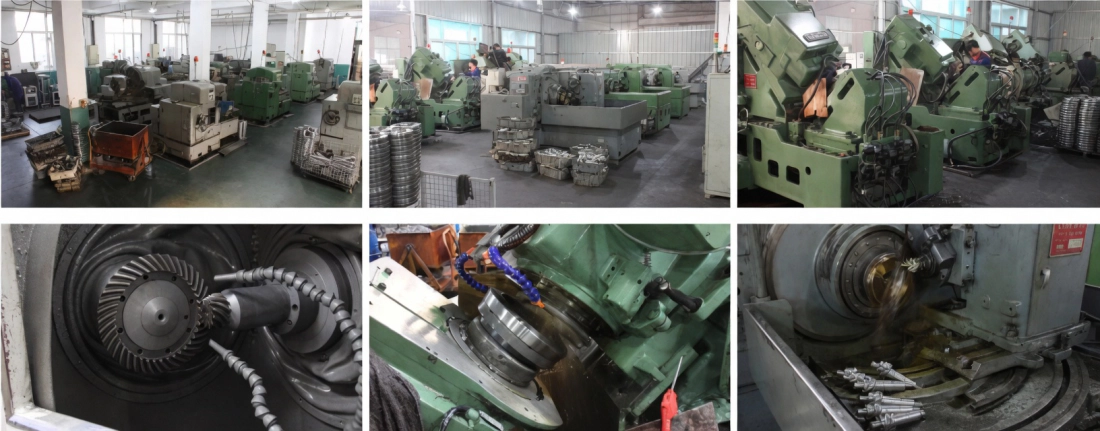
1. The Physics of Gear Noise: Where Does It Come From?
Gear noise originates from a phenomenon called transmission error — the deviation between the actual position of the output gear tooth and the theoretical position it would occupy if the gear set were geometrically perfect. Transmission error generates a fluctuating torque at the gear mesh, which excites the gear body, shaft, and housing into vibration. This vibration radiates from the housing surface as airborne noise.
Transmission error has two primary sources:
- Geometric error — deviations in tooth profile, pitch, and lead from the theoretical perfect form, introduced during manufacturing. ISO Grade 5–6 precision grinding reduces this to below 6 microns per tooth.
- Elastic deflection — under load, gear teeth deflect elastically. The deflection varies as each tooth pair enters and exits the mesh zone, creating a periodic torque fluctuation even in geometrically perfect gears. This is the irreducible minimum of gear noise — and it is where the contact ratio becomes the critical parameter.
2. Why Straight Bevel Gears Are Inherently Noisy
In a straight bevel gear, contact ratio is typically 1.2–1.5. A contact ratio of 1.2 means that for 80% of each tooth rotation cycle, only one pair of teeth is in contact — carrying the full load alone. For the remaining 20%, two pairs share the load.
The transition between single-pair and double-pair contact occurs instantaneously — a tooth pair either is or is not in contact across its full face width. This instantaneous transition creates a step-change in the load carried by each tooth pair, which generates an impact at the tooth pass frequency. At 1,450 rpm with 20 teeth, the tooth pass frequency is 483 Hz — in the range of maximum human hearing sensitivity and well within the range that generates structure-borne noise in machine frames and building structures.
Additionally, straight bevel gear contact begins simultaneously across the entire tooth face width — the contact line is parallel to the tooth axis. The sudden application of load across the full tooth width at entry creates a peak stress that radiates vibration into the gear body.
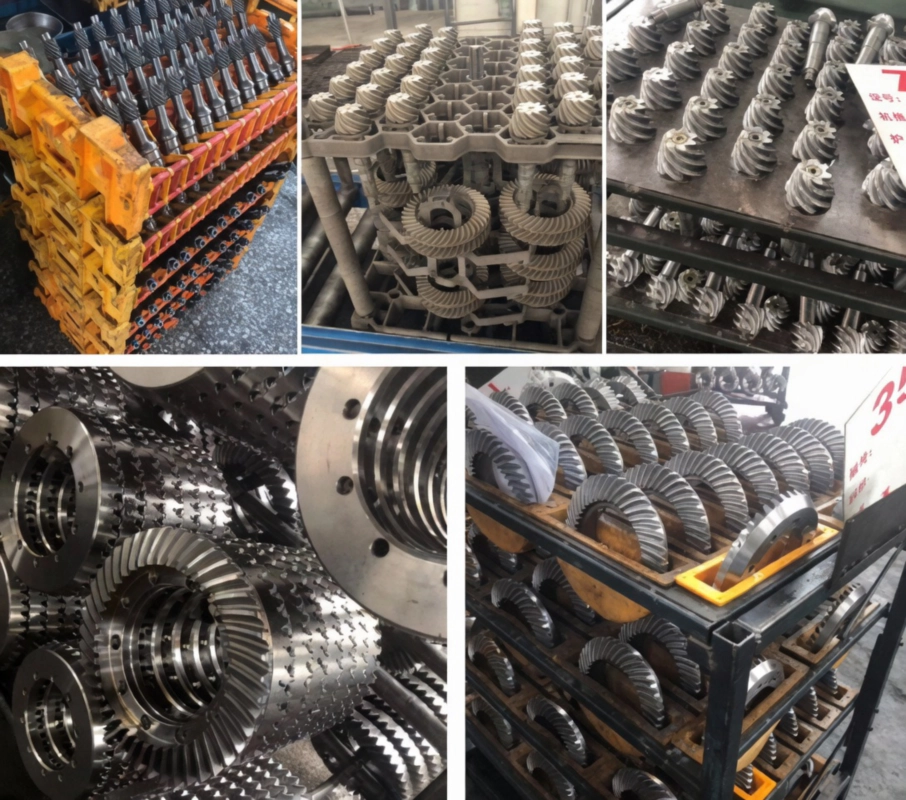
3. How Spiral Tooth Geometry Reduces Noise: Three Mechanisms
Mechanism 1: Higher Contact Ratio
Spiral bevel gears achieve contact ratios of 1.5–2.5, compared to 1.2–1.5 for straight bevel. A contact ratio above 2.0 means that at least two tooth pairs are always in contact simultaneously throughout the full rotation cycle — the transition from two-pair to three-pair contact is gradual, not instantaneous. The load variation across the mesh cycle is dramatically reduced, and the step-change impact that generates straight bevel gear noise is eliminated.
The contact ratio in a spiral bevel gear is the sum of the profile contact ratio (from the tooth profile depth) and the face contact ratio (from the spiral angle across the face width). The face contact ratio is directly related to the spiral angle — a 35-degree spiral angle with a face width of 40 mm produces a face contact ratio of approximately 0.8–1.0 on its own, added to a profile contact ratio of 1.2–1.4 gives a total of 2.0–2.4.
Mechanism 2: Progressive Contact Line
In a spiral bevel gear, the contact line between meshing teeth is diagonal across the tooth face — running from the toe corner of one tooth to the heel corner of the mating tooth. As the gear rotates, this contact line sweeps progressively across the tooth face rather than appearing and disappearing instantaneously.
The progressive sweep means the load builds gradually from zero (at contact initiation at the toe) to maximum (at mid-face) and diminishes gradually back to zero (at contact exit at the heel). This smooth force profile, replacing the step-function of straight bevel gears, eliminates the excitation frequency that generates the characteristic straight bevel whine.
Mechanism 3: Load Sharing Across Multiple Teeth
When two or more tooth pairs share the load simultaneously, the elastic deflection of each individual tooth is reduced proportionally. Smaller individual tooth deflections mean smaller periodic variation in the torque transmitted — and since transmission error (and hence noise) is directly proportional to this torque variation, higher contact ratio produces lower noise through this mechanism as well.
At a contact ratio of 2.0, the average tooth deflection is approximately half what it would be at a contact ratio of 1.0. This alone accounts for a theoretical 50% reduction in the transmission error amplitude — and a corresponding reduction in the vibration excitation force at the gear mesh.
4. Quantifying the Noise Reduction: Measured Data
| கியர் வகை | Contact Ratio | Typical Noise Level | Noise Reduction vs Straight Bevel |
|---|---|---|---|
| Straight bevel gear | 1.2 – 1.5 | 75 – 90 dB | Baseline |
| Spiral bevel gear (standard industrial) | 1.5 – 2.0 | 65 – 72 dB | 40 – 50% reduction |
| Spiral bevel gear (ISO Grade 5–6, precision ground) | 1.8 – 2.5 | 60 – 68 dB | 50 – 60% reduction |
| Ever Power Z Series (stage machinery grade) | 2.0 – 2.5 | 58 – 62 dB | 55 – 65% reduction |
To put the dB numbers in perspective: the human ear perceives a 10 dB reduction as roughly half as loud. A 15 dB reduction from 83 dB (straight bevel) to 68 dB (precision spiral bevel) is perceived as approximately 70% quieter — a dramatic difference in the working environment, regardless of what the percentage figures suggest.

5. Manufacturing Precision: The Multiplier on Noise Performance
The tooth geometry creates the theoretical noise reduction potential. Manufacturing precision determines how closely the actual gear achieves that potential. A spiral bevel gear with the correct theoretical geometry but poor manufacturing accuracy will exhibit high geometric transmission error — partially or fully negating the contact ratio advantage.
ISO Grade 5–6 precision, achieved through Gleason/Klingelnberg cutting followed by precision grinding, limits pitch error to below 6 microns and profile error to below 8 microns. At these tolerance levels, the geometric contribution to transmission error is small compared to the elastic deflection component — meaning the gear performs close to its theoretical noise limit.
Ever Power achieves ISO Grade 5–6 through dedicated spiral bevel grinding lines and 100% CMM inspection of gear tooth geometry before assembly. The contact pattern is physically verified under light load before the gearbox is closed — an assembly step that confirms the manufacturing accuracy translates into correct gear mesh geometry in the assembled unit.
6. Noise in the Context of Application Requirements
Many food production facilities set a 70 dB floor noise limit for operator health and safety. Straight bevel gears at 80–85 dB exceed this limit. Ever Power spiral bevel at 60–68 dB meets it comfortably.
Clean-room environments often specify ambient noise below 65 dB. Spiral bevel gearboxes with sealed-for-life bearings and ISO Grade 5 grinding are routinely achieving 60–63 dB in pharmaceutical installations.
Opera house and theater specifications require fly system drives to be inaudible from audience seating. The Ever Power Z Series, with 5-axis housing machining and selective gear assembly, routinely meets 58–62 dB specifications.
Cooling tower fan drives on office buildings must not transmit audible noise into occupied spaces. Spiral bevel gearboxes at 60–68 dB with vibration-isolating mounts are the standard solution for this application class.
Customer Cases
Belgium — Textile Machinery OEM
Switched from straight bevel to Ever Power spiral bevel gearboxes on a multi-spindle weaving machine. Noise measured before and after: 82 dB reduced to 63 dB — a 19 dB reduction, perceived as approximately 80% quieter. Vibration-related bearing failures dropped from four per year to zero in the following 24 months.
“Our operators noticed immediately. The machine floor is quiet enough for normal conversation now.” — Machine Design Engineer
Germany — Food Processing Plant
Packaging conveyor using worm gearboxes measured at 79 dB. Replaced with six Ever Power 2:1 spiral bevel units. Measured noise: 64 dB — well below the 70 dB occupational health limit. No noise-related operator complaints since installation. Annual health and safety audit passed without gear drive noise as an action item for the first time in three years.
“Passing the noise audit without any further acoustic treatment was the unexpected bonus.” — Operations Manager, Bavaria
Netherlands — Office Building Cooling Tower
Cooling tower fan drives on a Rotterdam office building were generating noise complaints from adjacent offices. Ever Power 1.5:1 spiral bevel gearboxes with vibration isolation mounts replaced older straight bevel units. Noise complaints ceased immediately after replacement. “The building management team had been trying to solve this for two years. New gearboxes solved it in two days.” — Facilities Manager
FAQ
Need a quiet right-angle gearbox for a noise-sensitive application?
Ever Power spiral bevel gearboxes achieve 60–68 dB at rated load — with noise test certificates available on request. CE certified, Netherlands-registered, fast European delivery.