
The transmission ratio of a スパイラルベベルギアボックス is the single parameter most engineers look at first — and often the one that causes the most confusion in practice. A 1:1 ratio does not mean the gearbox does nothing. A 3:1 ratio does not mean you always need a slower output. This guide explains what each standard ratio actually delivers, how to calculate the output you need, and which ratio fits which industrial application.
1. What Does Transmission Ratio Mean in a Spiral Bevel Gearbox?
The transmission ratio — also called gear ratio or reduction ratio — defines the relationship between input shaft speed and output shaft speed:
Example: Input 1,450 rpm / Output 725 rpm = Ratio 2:1
The ratio also determines torque multiplication. Output torque equals input torque multiplied by the ratio (minus efficiency losses). A 3:1 ratio gearbox receiving 100 N.m at the input delivers approximately 282 N.m at the output (100 x 3 x 0.94 efficiency).
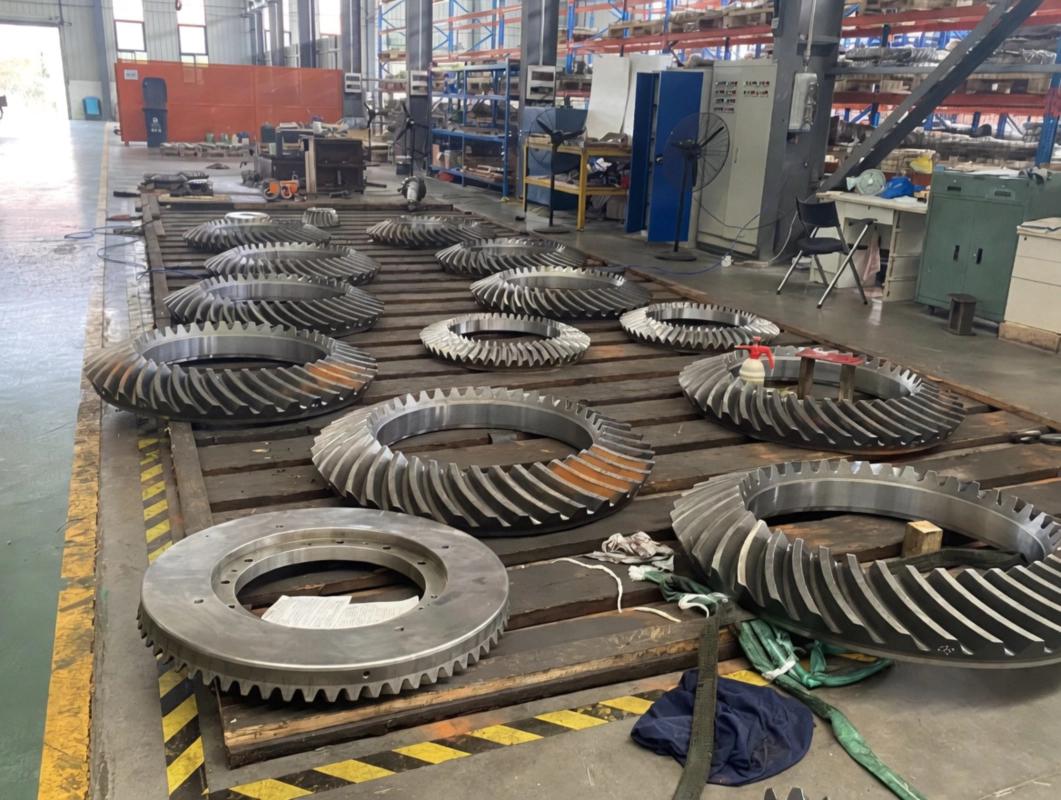
Standard Ever Power spiral bevel gearboxes are available in four ratios: 1:1, 1.5:1, 2:1, and 3:1. All four ratios share the same housing envelope within each size series — simplifying spare parts management and machine design.
2. Ratio Overview: Output Speed and Torque at 1,450 rpm Input
| Ratio | Output Speed (rpm) | Torque Multiplication | Efficiency | Primary Use |
|---|---|---|---|---|
| 1:1 | 1,450 rpm | 1x (direction change only) | 96% | Steering boxes, PTO drives, machine tool shafts |
| 1.5:1 | 967 rpm | 1.43x | 95.5% | Fan drives, cooling towers, grain elevators |
| 2:1 | 725 rpm | 1.9x | 95% | Conveyors, mixers, agitators, packaging lines |
| 3:1 | 483 rpm | 2.82x | 94% | Slow conveyors, kilns, screw drives, heavy mixers |
3. The 1:1 Ratio: Direction Change, Not Speed Change
The 1:1 ratio is the most misunderstood configuration in the spiral bevel gearbox range. Engineers occasionally ask why a gearbox is needed at 1:1 — if the speed does not change, surely a simple coupling would do? The answer is that 1:1 spiral bevel gearboxes perform a function a coupling cannot: they change the direction of the drive shaft by 90 degrees.
At 1:1, the output shaft rotates at exactly the same speed as the input shaft. Efficiency peaks at 96% because both gears have the same tooth count — the gear mesh geometry is perfectly symmetrical and transmission error is minimised. This is why 1:1 units are preferred for:
- Agricultural PTO steering boxes — redirecting tractor power to implement shafts without speed change
- Machine tool distribution shafts — turning a single drive shaft to feed multiple spindle stations at 90 degrees
- Printing press line shafts — maintaining exact speed synchronisation across press sections
- Synchronized twin-shaft drives — both outputs of a 2-extended shaft unit rotate at identical speed
4. The 1.5:1 Ratio: Light Reduction for Fan and Elevator Drives
The 1.5:1 ratio is the right choice when the motor runs at standard speed (typically 1,450 rpm from a 4-pole motor) and the driven equipment operates most efficiently at approximately 960–1,000 rpm. This covers a wide range of industrial fans, cooling tower fans, grain elevators, and centrifugal pumps that cannot be driven directly at motor speed.
The 1.5:1 ratio delivers 1.43x torque multiplication at 95.5% efficiency — providing meaningful torque increase at very low energy cost. For fan drives in particular, this ratio allows motor selection at the standard 4-pole speed without requiring a variable frequency drive (VFD) solely for speed adjustment.
Typical 1.5:1 applications: Cooling tower fans | Industrial process fans | Grain bucket elevators | Centrifugal pump drives | Textile card machine drives
5. The 2:1 Ratio: The Most Widely Used Industrial Configuration
The 2:1 ratio is the most frequently specified configuration in the Ever Power spiral bevel gearbox range — and across the industrial gearbox market generally. It delivers 725 rpm output from a standard 1,450 rpm motor, with a torque multiplication of 1.9x at 95% efficiency. This combination of moderate speed reduction and significant torque increase fits the largest number of industrial driven equipment types.
Primary 2:1 applications:
725 rpm output drives the head pulley at a belt speed appropriate for most standard-width conveyor systems without additional inline reduction.
Many agitator impellers run optimally at 700–800 rpm. A 2:1 bevel gearbox provides this speed from a standard motor without an additional inline reducer.
Right-angle drive at 2:1 fits the majority of sealing jaw, filling head, and labelling station speed requirements on standard packaging lines.
Portioning conveyors, slicers, and grading systems operating at 700–800 rpm benefit from 2:1 spiral bevel units with food-grade shaft seal options.
6. The 3:1 Ratio: Maximum Torque from a Single Spiral Bevel Stage
The 3:1 ratio delivers the highest torque multiplication available in a single-stage spiral bevel gearbox — 2.82x input torque at 94% efficiency. Output speed from a standard motor is 483 rpm. This ratio is the correct choice when slow-running, high-torque output is needed without adding a second reduction stage.
Primary 3:1 applications: Heavy screw conveyors | Rotary kiln auxiliary drives | Slow-speed mixers for viscous materials | Concrete mixer drives | Stage machinery winch drives | Mining conveyor head pulley drives at moderate power
For requirements below 483 rpm output from a 1,450 rpm motor, a two-stage arrangement — spiral bevel plus inline helical — is typically the most efficient and cost-effective solution. Ever Power designs complete two-stage drive packages on request.
7. Can a Spiral Bevel Gearbox Run in Reverse? Speed Increase Mode
Yes — all Ever Power spiral bevel gearboxes are fully bidirectional. By using the crown gear shaft as the input rather than the pinion shaft, any ratio operates in reverse: a 2:1 gearbox becomes a 1:2 speed increaser delivering 2,900 rpm output from a 1,450 rpm motor input.
Speed increase operation is used in generator drives, test stands, and high-speed centrifuge drives where a low-speed prime mover must drive a high-speed output device. Bearing loads and oil fill requirements change in speed-increase mode — always advise Ever Power of the intended power flow direction when ordering.
8. Custom Ratios: Ever Power Design Capability
Standard ratios cover the majority of industrial requirements. For non-standard ratios — 1.2:1, 1.8:1, 2.5:1, 4:1, 5:1 — Ever Power designs and manufactures custom spiral bevel gear sets within our existing housing series. Custom ratio units are available from 15–45 working days with full CE documentation.
For ratios above 6:1, we design two-stage bevel-helical combinations that maintain overall efficiency above 90% while achieving ratios up to 45:1 in a single housing.
Customer Cases
Spain — Grain Cooperative
Grain elevator drives required 960 rpm output from 1,450 rpm motors. The 1.5:1 Ever Power spiral bevel gearbox was a precise match — no VFD required, and the 95.5% efficiency delivered measurable energy saving vs the previous worm gear units running at 72% efficiency.
“The ratio matched our equipment perfectly. We replaced 12 units across the facility.” — Facilities Manager, Seville
Italy — Packaging Equipment OEM
Standard 2:1 Ever Power spiral bevel gearboxes integrated across a bottling line. All 18 drive stations use identical units — one spare covers the entire line. “Standardising on the 2:1 ratio simplified our spare parts policy enormously.” — Production Engineering Manager, Milan
Mexico — Cement Plant
Kiln auxiliary drive required 480 rpm output for controlled shell rotation during maintenance. The 3:1 ratio Ever Power unit delivered 483 rpm from the standard motor — close enough for the barring drive application. “No VFD, no additional reduction stage. The 3:1 spiral bevel solved it cleanly.” — Plant Mechanical Engineer
FAQ
Not sure which ratio fits your drive?
Send Ever Power your motor speed and required output speed. We confirm the correct ratio, select the matched unit, and return a drawing within 48 hours.