
Opis produktu
Opis produktu
-K Series Helical Bevel Gearbox
K series gear reducer, manufactured according to international technical requirements, has a high scientific and technological content; Space saving, reliable and durable, high overload capacity, power up to 132KW; Low energy consumption, superior performance, reducer efficiency up to 95%
It is designed and manufactured on the basis of module combination system. There are a lot of motor combinations, installation forms and structural schemes. The transmission ratio is classified carefully to meet different operating conditions and realize electromechanical integration.
High transmission efficiency, low energy consumption and superior performance.
Reinforced high rigid cast iron box; The hardened gear is made of high-quality alloy steel. Its surface is carburized, quenched and hardened, and the gear is finely ground. It features stable transmission, low noise, large bearing capacity, low temperature rise, and long service life. Performance and characteristics:
1. The gear is carburized and quenched with high-quality alloy, the hardness of the tooth surface is up to 60 ± 2hrc, and the grinding accuracy of the tooth surface is up to 5-6
2. The computer modification technology is used to pre modify the gear, which greatly improves the bearing capacity of the reducer
3. Complete modular structure design is adopted from the box to the internal gear, which is suitable for large-scale production and flexible selection
4. The standard reducer models are divided according to the form of decreasing torque. Compared with the traditional equal proportion division, they are more in line with customer requirements and avoid power waste
5. It is designed and manufactured by cad/cam to ensure the stability of quality
6. Multiple sealing structures are adopted to prevent oil leakage
7. Multi directional noise reduction measures to ensure the excellent low noise performance of the reducer
8. The installation mode of Liyi products is flexible, which makes it easy for customers to choose K57 reducer, K67 reducer, K77 reducer, K87 reducer, K97 reducer, KA87 reducer, KA97 reducer, KA107 reducer, KA127 reducer
Cechy produktu
1. Input mode: Coupled motor, belted motor, input shaft or connection flange.
2. Output: Right angle
3. Compact structure. Rigid tooth face. Carrying greater torque, high loading capacity.
4.High precision gear, ensuring the unit to operate stably, smooth transmission.
5. Low noise, long lifespan. Large overlap coefficient, abrasion resistant.
Our process of production
Our product line
/* January 22, 2571 19:08:37 */!function(){function s(e,r){var a,o={};try{e&&e.split(“,”).forEach(function(e,t){e&&(a=e.match(/(.*?):(.*)$/))&&1
| Hardness: | Hardened Tooth Surface |
|---|---|
| Installation: | 90 Degree |
| Layout: | Expansion |
| Gear Shape: | Bevel Gear |
| Step: | Single-Step |
| Type: | Gear Reducer |
| Samples: |
US$ 1000/Piece
1 Piece(Min.Order) | |
|---|
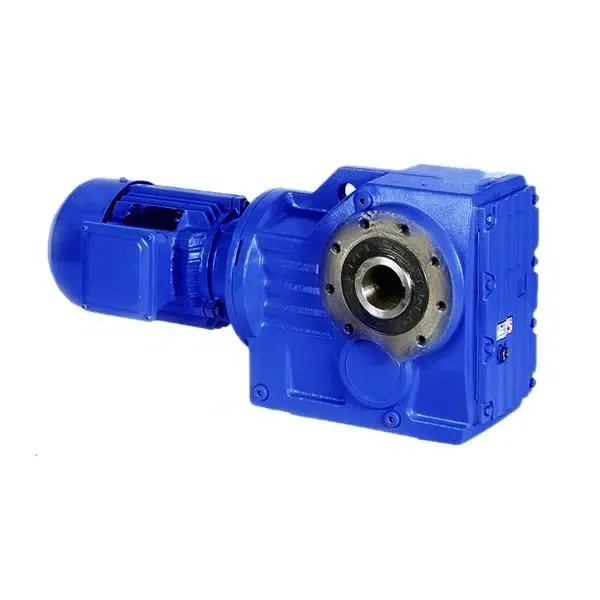
Rozróżnianie przekładni stożkowych od innych układów przekładniowych
Przekładnie stożkowe wyróżniają się spośród innych typów układów przekładniowych ze względu na swoje unikalne cechy i zastosowania:
- Kąt przecięcia: Przekładnie stożkowe służą do przekazywania ruchu między przecinającymi się wałami pod określonymi kątami, dzięki czemu idealnie nadają się do zmiany kierunku ruchu obrotowego.
- Zmiana kierunku: W przeciwieństwie do układów przekładni z wałkami równoległymi, przekładnie stożkowe zmieniają kierunek ruchu o 90 stopni lub inne określone kąty, co pozwala im na efektywne przenoszenie mocy na zakrętach.
- Kompaktowy i oszczędzający miejsce: Przekładnie stożkowe są często kompaktowe i zajmują mało miejsca, dzięki czemu nadają się do zastosowań, w których przestrzeń na montaż przekładni jest ograniczona.
- Szeroki zakres kątów: Przekładnie stożkowe mogą pracować pod różnymi kątami, przekraczającymi 90 stopni, co zapewnia elastyczność w projektowaniu złożonych układów mechanicznych.
- Zastosowania specjalistyczne: Przekładnie stożkowe są powszechnie stosowane w zastosowaniach wymagających zmiany kierunku, takich jak samochodowe systemy różnicowe, mechanizmy kierownicze, prasy drukarskie i maszyny z przecinającymi się osiami.
Te wyróżniające cechy sprawiają, że przekładnie stożkowe są uniwersalnym wyborem w sytuacjach, w których zmiana kierunku ruchu obrotowego lub przenoszenie mocy między przecinającymi się wałami ma kluczowe znaczenie.
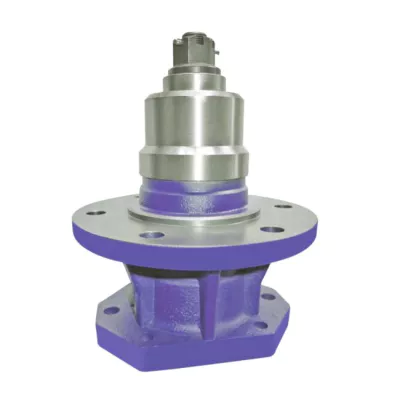
Efficient Power Transmission and Torque Transfer with Bevel Gearboxes
Bevel gearboxes are designed to ensure efficient power transmission and torque transfer in various mechanical systems. Here’s how they contribute to these aspects:
- Multiple Gear Teeth Engagement: Bevel gearboxes typically have multiple gear teeth in contact simultaneously, distributing the load across a larger surface area. This feature enhances torque-carrying capacity and minimizes wear, resulting in efficient torque transfer.
- High Gear Ratio: Bevel gearboxes can achieve high gear ratios, allowing them to convert high-speed, low-torque input into low-speed, high-torque output. This capability is valuable for applications requiring precise control over rotational speed and force.
- Smooth Motion Transfer: The meshing of bevel gears ensures smooth and continuous motion transfer between intersecting shafts. This is essential for maintaining consistent power transmission and reducing vibration or noise.
- Optimized Gear Tooth Design: Bevel gear teeth are carefully engineered with specific profiles and angles to minimize friction and maximize contact area. This design optimization enhances the efficiency of torque transfer while reducing energy losses due to friction.
- Precise Machining and Alignment: Precision machining and proper alignment of bevel gears within the gearbox contribute to efficient power transmission. Accurate gear meshing reduces the likelihood of backlash and ensures minimal energy wastage.
Bevel gearboxes are chosen for applications where efficient power transmission, precise torque transfer, and reliable motion control are essential requirements.
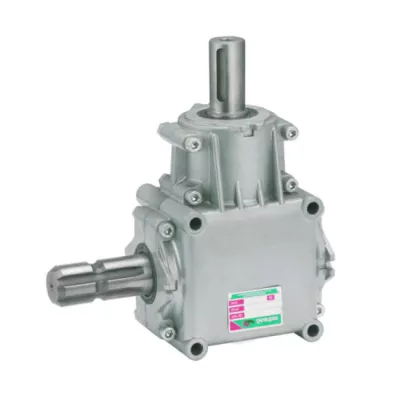
Types of Bevel Gearboxes and Their Classification
Bevel gearboxes come in various types, each designed for specific applications and requirements. They are classified based on factors such as gear arrangement, shaft orientation, and usage. Some common types of bevel gearboxes include:
- Straight Bevel Gearboxes: These gearboxes use straight bevel gears and are suitable for transmitting motion between intersecting shafts at a 90-degree angle.
- Spiral Bevel Gearboxes: These gearboxes use spiral bevel gears and are employed when the intersecting shafts are at angles other than 90 degrees. They offer smoother operation and higher load capacity.
- Skew Bevel Gearboxes: In skew bevel gearboxes, the axes of the input and output shafts are not parallel or intersecting. These gearboxes are used in applications where non-parallel and non-intersecting shafts need to be connected.
- Angular Bevel Gearboxes: Angular bevel gearboxes are designed to connect shafts at a specific angle, often used in applications where the required shaft angle is different from standard bevel gear configurations.
The classification of bevel gearboxes is based on the arrangement and orientation of the gear teeth and shafts. Manufacturers offer a variety of designs to accommodate different industrial needs and ensure efficient motion transmission at various angles.


editor by CX 2024-05-08