Descripción del Producto
Fotos detalladas
Descripción del Producto
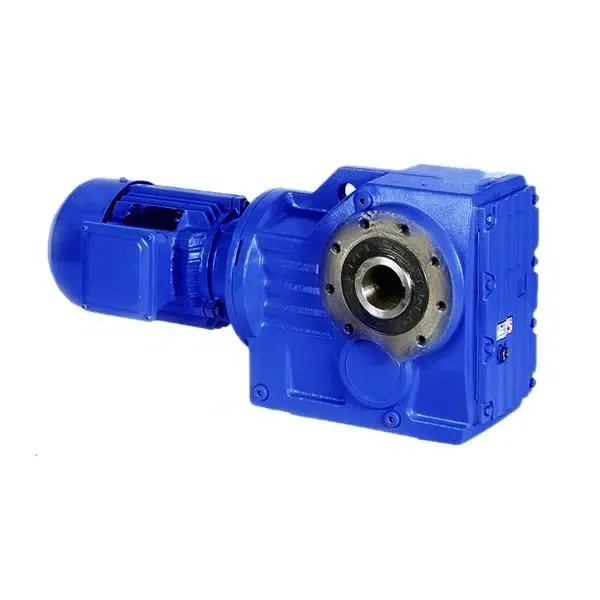
-K Series Helical Bevel Gearbox
K series gear reducer, manufactured according to international technical requirements, has a high scientific and technological content; Space saving, reliable and durable, high overload capacity, power up to 132KW; Low energy consumption, superior performance, reducer efficiency up to 95%
It is designed and manufactured on the basis of module combination system. There are a lot of motor combinations, installation forms and structural schemes. The transmission ratio is classified carefully to meet different operating conditions and realize electromechanical integration.
High transmission efficiency, low energy consumption and superior performance.
Reinforced high rigid cast iron box; The hardened gear is made of high-quality alloy steel. Its surface is carburized, quenched and hardened, and the gear is finely ground. It features stable transmission, low noise, large bearing capacity, low temperature rise, and long service life. Performance and characteristics:
1. The gear is carburized and quenched with high-quality alloy, the hardness of the tooth surface is up to 60 ± 2hrc, and the grinding accuracy of the tooth surface is up to 5-6
2. The computer modification technology is used to pre modify the gear, which greatly improves the bearing capacity of the reducer
3. Complete modular structure design is adopted from the box to the internal gear, which is suitable for large-scale production and flexible selection
4. The standard reducer models are divided according to the form of decreasing torque. Compared with the traditional equal proportion division, they are more in line with customer requirements and avoid power waste
5. It is designed and manufactured by cad/cam to ensure the stability of quality
6. Multiple sealing structures are adopted to prevent oil leakage
7. Multi directional noise reduction measures to ensure the excellent low noise performance of the reducer
8. The installation mode of Liyi products is flexible, which makes it easy for customers to choose K57 reducer, K67 reducer, K77 reducer, K87 reducer, K97 reducer, KA87 reducer, KA97 reducer, KA107 reducer, KA127 reducer
Descripción del Producto
/* January 22, 2571 19:08:37 */!function(){function s(e,r){var a,o={};try{e&&e.split(“,”).forEach(function(e,t){e&&(a=e.match(/(.*?):(.*)$/))&&1
| Hardness: | Hardened Tooth Surface |
|---|---|
| Installation: | 90 Degree |
| Layout: | Expansion |
| Gear Shape: | Engranaje cónico |
| Step: | Single-Step |
| Tipo: | Gear Reducer |
| Samples: |
US$ 1000/Piece
1 Piece(Min.Order) | |
|---|
Cómo distinguir las cajas de engranajes cónicos de otros sistemas de engranajes.
Las cajas de engranajes cónicos se distinguen de otros tipos de sistemas de engranajes por sus características y aplicaciones únicas:
- Ángulo de intersección: Las cajas de engranajes cónicos están diseñadas para transmitir movimiento entre ejes que se cruzan en ángulos específicos, lo que las hace ideales para cambiar la dirección del movimiento de rotación.
- Cambio de dirección: A diferencia de los sistemas de engranajes de ejes paralelos, las cajas de engranajes cónicos cambian la dirección del movimiento en 90 grados u otros ángulos especificados, lo que les permite transmitir potencia de manera eficiente en las curvas.
- Compacto y ahorra espacio: Las cajas de engranajes cónicos suelen ser compactas y ahorran espacio, lo que las hace adecuadas para aplicaciones con espacio limitado para el montaje de engranajes.
- Amplia gama de ángulos: Las cajas de engranajes cónicos pueden manejar diversas configuraciones angulares superiores a 90 grados, lo que proporciona flexibilidad en el diseño de sistemas mecánicos complejos.
- Aplicaciones especializadas: Las cajas de engranajes cónicos se utilizan habitualmente en aplicaciones que requieren cambios de dirección, como sistemas diferenciales de automóviles, mecanismos de dirección, imprentas y maquinaria con ejes que se cruzan.
Estas características distintivas convierten a las cajas de engranajes cónicos en una opción versátil para situaciones en las que es esencial cambiar la dirección del movimiento de rotación o transmitir potencia entre ejes que se cruzan.
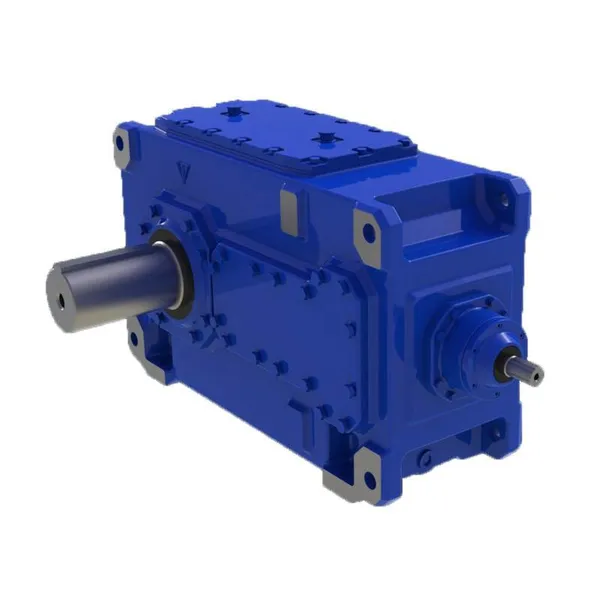
Limitations of Torque and Speed Handling in Bevel Gearboxes
While bevel gearboxes offer numerous advantages, they do have limitations in terms of the maximum torque and speed they can handle:
- Torque Limitations: The torque capacity of a bevel gearbox is influenced by factors such as the size of the gears, the material used, and the tooth geometry. Excessive torque can lead to gear tooth failure, wear, or even breakage.
- Speed Limitations: High-speed applications can pose challenges for bevel gearboxes. As rotational speed increases, the centrifugal forces acting on the gears also increase, leading to potential issues with stability, vibration, and heat generation.
- Heat Dissipation: Bevel gearboxes may generate heat due to friction and the load-carrying nature of the gears. Prolonged operation at high speeds or under heavy loads can result in increased heat, which may require additional cooling mechanisms.
- Material and Design: The material used for the gears and gearbox housing, as well as the design and manufacturing quality, play a significant role in determining the torque and speed limits of the gearbox. Inadequate material selection or poor design can result in premature failure.
- Application-Specific Considerations: The limitations of bevel gearboxes may vary based on the specific application requirements, environmental conditions, and operational factors. It’s important to carefully assess the suitability of a bevel gearbox for a given task.
Engineers and designers need to carefully analyze the torque and speed requirements of an application to ensure that the selected bevel gearbox can operate safely and effectively within its specified limits.
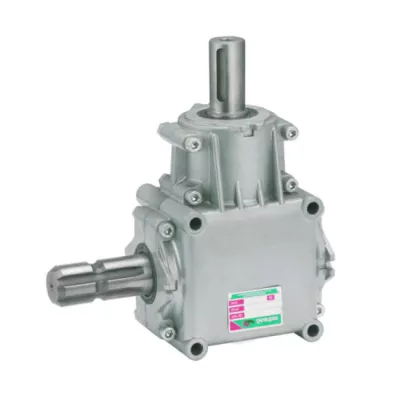
Types of Bevel Gearboxes and Their Classification
Bevel gearboxes come in various types, each designed for specific applications and requirements. They are classified based on factors such as gear arrangement, shaft orientation, and usage. Some common types of bevel gearboxes include:
- Straight Bevel Gearboxes: These gearboxes use straight bevel gears and are suitable for transmitting motion between intersecting shafts at a 90-degree angle.
- Spiral Bevel Gearboxes: These gearboxes use spiral bevel gears and are employed when the intersecting shafts are at angles other than 90 degrees. They offer smoother operation and higher load capacity.
- Skew Bevel Gearboxes: In skew bevel gearboxes, the axes of the input and output shafts are not parallel or intersecting. These gearboxes are used in applications where non-parallel and non-intersecting shafts need to be connected.
- Angular Bevel Gearboxes: Angular bevel gearboxes are designed to connect shafts at a specific angle, often used in applications where the required shaft angle is different from standard bevel gear configurations.
The classification of bevel gearboxes is based on the arrangement and orientation of the gear teeth and shafts. Manufacturers offer a variety of designs to accommodate different industrial needs and ensure efficient motion transmission at various angles.


editor by CX 2024-05-02